Manual labor can't keep pace with today's demands. Throughput targets keep climbing, skilled operators are harder to find, and auditors expect documented proof that every fill, seal, and label meets spec. Automation has stopped being optional for most producers.
This guide breaks down 10 essential types of packaging machines, how they differ, and how to pick the right one for your product line.
Key Takeaways
- Packaging machines automate filling, sealing, weighing, labeling, and inspection across regulated industries.
- Each of the ten core machine types is built for a specific product form or production stage, not a generic fit.
- Matching machine to product type, volume, and budget beats chasing trends.
- A single-source equipment partner simplifies building and maintaining a complete, compliant line.
What Is Packaging Machinery and Why Does It Matter
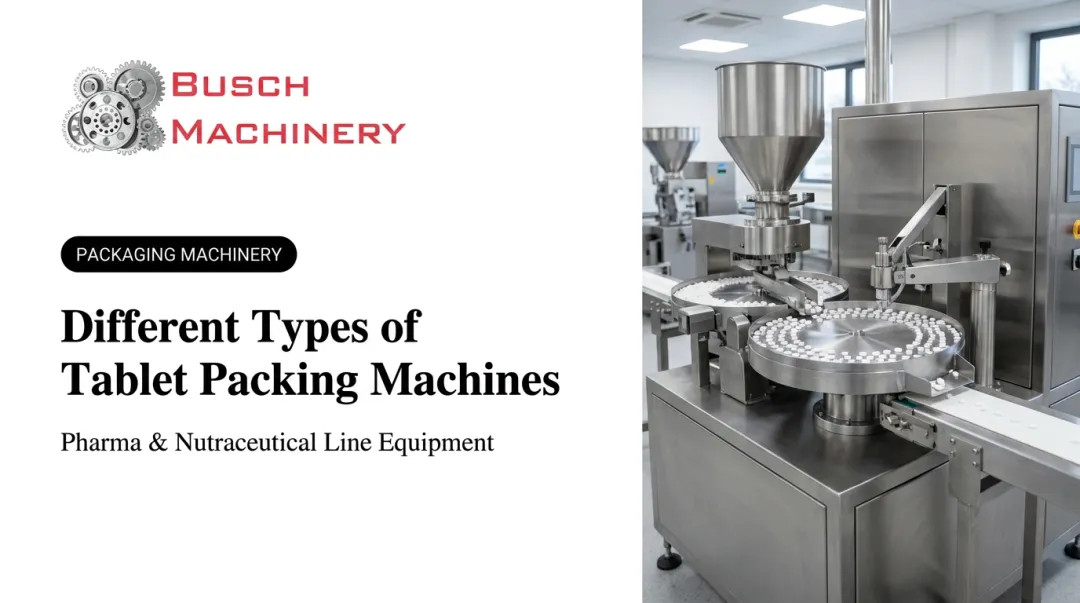
Packaging machinery is exactly what it sounds like: equipment that automates filling, sealing, labeling, weighing, inspecting, and packing products for storage, shipping, and retail sale. It shows up on production floors across chemical, pharmaceutical, cosmetic, food, beverage, and nutraceutical manufacturing.
This is the hands-on machinery standing between a raw formulation and a finished case ready for a truck. A plant manager doesn't care about theory; they care whether the filler hits weight and the capper doesn't jam at 3 a.m.
Why It Matters in Manufacturing
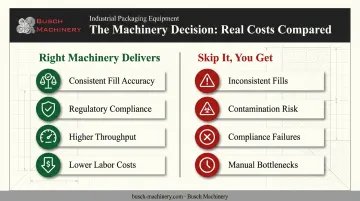
The right machinery delivers:
- Consistent fill accuracy
- Regulatory compliance
- Higher throughput
- Lower labor costs
Skip it, and you get the opposite:
- Inconsistent fills
- Contamination risk
- Compliance failures
- Manual bottlenecks that cap output no matter how much overtime you schedule
Automation's payoff is measurable. When Napco Brands installed two cobot palletizers, the company freed up eight operators for more specialized work rather than repetitive end-of-line stacking, according to a Packaging World case study collection on palletizing. That's a full shift in how a plant deploys its people, not a minor tweak.
Types of Packaging Machines
Packaging machinery comes in many specialized forms. Each type below is built around a specific product form, be it liquid, powder, solid, or granular, a particular package style, or a distinct stage of production. Most full packaging lines combine several of these machine types in sequence, not just one.
Filling Machines
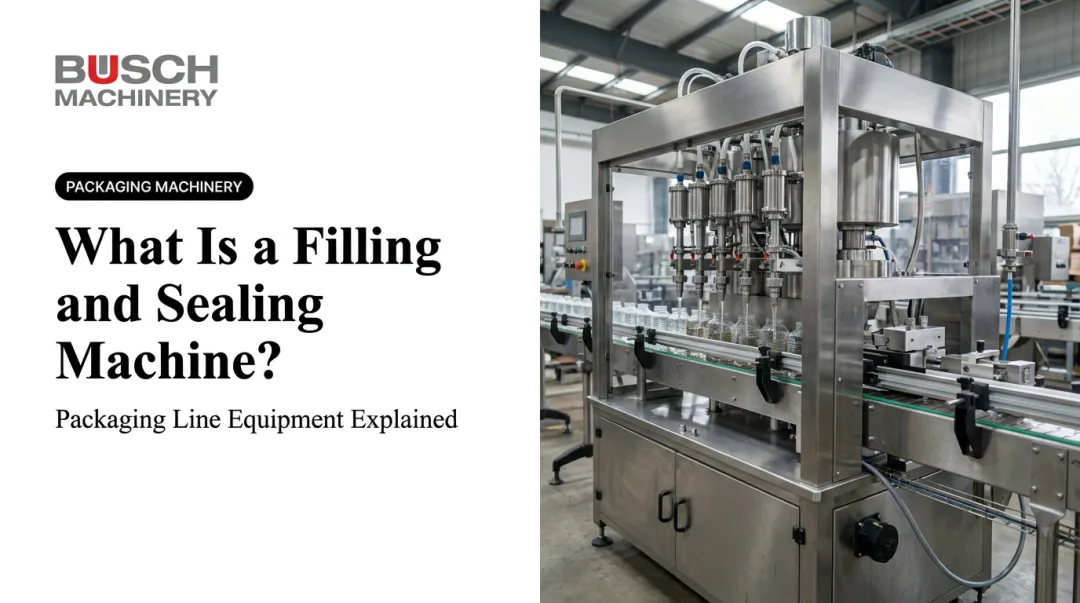
Filling machines dispense precise, repeatable quantities of liquid, powder, or granular product into bottles, jars, or pouches. Three methods dominate:
- Volumetric fillers release a predetermined product volume, ideal for free-flowing dry goods.
- Auger fillers meter powders with a rotating auger, common for spices, coffee, and protein powders.
- Piston fillers use a piston-and-cylinder action for viscous products like sauces, creams, and honey.
Fill accuracy carries direct cost implications. Even an intentional 1% overfill turns into real material loss across a large production run, according to Food Engineering's analysis of filling giveaway. Best fit: beverage, chemical, pharmaceutical, and cosmetic products where giveaway control directly hits the bottom line.
Capping Machines
Capping machines apply and torque caps, lids, or closures onto filled containers automatically, seating each one consistently without skewing while preserving seal integrity. Many also create the tamper-evident band required for certain retail pharmaceutical products under federal packaging rules.
Ideal for: bottled liquids, chemicals, and pharmaceuticals that need consistent seal integrity at high line speeds, where a single loose cap can trigger a full pallet rejection.
Labeling Machines
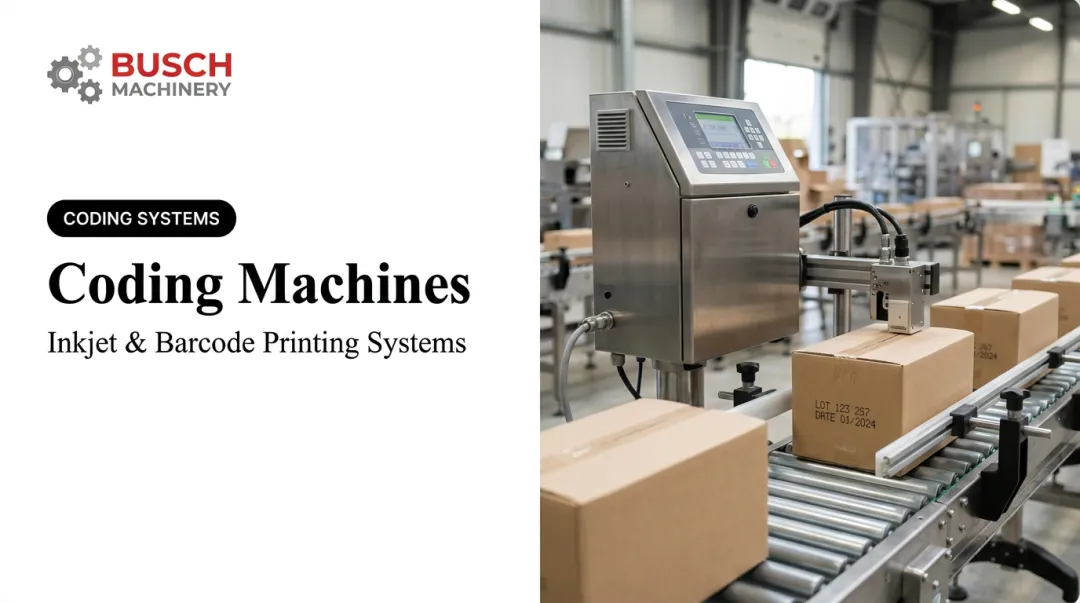
Labeling machines apply pressure-sensitive labels, sleeves, or wraps for branding, batch coding, and traceability. This is where compliance gets literal: food labels must list ingredients by common name in descending order of predominance, and drug packaging must carry a lot number tying each unit back to its manufacturing history.
Best fit: regulated industries like food and pharma, where every unit needs accurate ingredient statements, lot codes, and scannable barcodes.
Vertical Form Fill Seal (VFFS) Machines
VFFS machines form a bag from a roll of film, fill it vertically, and seal it in one continuous motion. Speeds vary enormously by product and bag style. Some frozen-food applications run around 15 bags per minute, while high-speed snack lines can exceed 150.
Well suited to: powders, granules, snacks, and dry goods that need high-speed vertical bagging with minimal film waste.
Horizontal Form Fill Seal (HFFS) & Flow Wrapping Machines
HFFS, better known as flow wrapping, forms and seals packages horizontally from a single film roll, producing that familiar pillow-style wrap. Instead of relying on gravity like VFFS, product moves through the machine horizontally as film wraps and seals around it.
Best fit: bars, candies, baked goods, and other solid, horizontally-oriented products that need fast, low-cost primary packaging.
Multihead Weighers
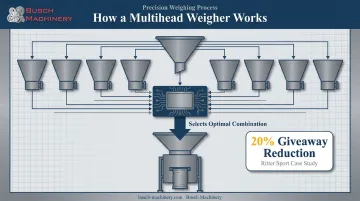
Multihead weighers split product across multiple weigh hoppers, then calculate which combination of heads lands closest to the target weight before dispensing to a bagger or filler. Running several heads in parallel supports higher speed and tighter accuracy than a single sequential scale.
Ritter Sport cut product giveaway by 20% after installing a 24-head weigher running up to 80 packs per minute, per Ishida's case study on multihead weighing in confectionery manufacturing. A strong fit for: snacks, frozen foods, produce, and granular products where minimizing giveaway matters as much as speed.
Check Weighers
Check weighers verify finished package weight in-line, automatically flagging or rejecting out-of-spec packages before they ever reach a shipping dock. They function as a documented quality-control checkpoint built into the line.
Some operations combine this function with contamination screening in a single unit. Busch Machinery's BM-GC series, for example, pairs check weighing with metal detection on one conveyor, giving plants weight verification and foreign-material screening without running two separate machines.
Best fit: regulated industries that need documented weight compliance alongside consistent quality control.
Metal Detectors & Inspection Systems
Metal detectors scan packaged product on a conveyor to catch metal contaminants or foreign material before it reaches a customer. Food safety codes like SQF and BRCGS specifically call out metal detection as a required foreign-body control for many production lines.
Works best for: food, pharmaceutical, and consumer goods manufacturers that need to satisfy HACCP requirements or pass third-party safety audits. Combo units that bundle metal detection with check weighing let smaller plants meet both requirements in one footprint.
Cartoning Machines
Cartoning machines erect, fill, and close cartons around products, creating sturdy, stackable, shelf-ready secondary packaging. Horizontal and vertical models exist depending on how the product loads into the carton, whether that's a bottle, blister pack, tube, or sachet.
Best fit: pharmaceutical, cosmetic, and consumer goods brands that need branded, retail-ready carton packaging for products already sealed in primary packaging.
Palletizers & End-of-Line Automation
Palletizers automatically stack finished cases onto pallets for shipping. They're typically paired with case packers, case erectors, and case sealers to complete the line from filled product to loading dock.
Ideal for: high-volume operations looking to cut manual labor, reduce warehouse injury risk, and speed up outbound shipping.
Busch Machinery supplies complete end-of-line automation alongside its filling, weighing, and inspection systems, letting manufacturers source an entire line, from first fill to final pallet wrap, through one partner instead of stitching together equipment from a half-dozen vendors.
How to Choose the Right Type of Packaging Machine
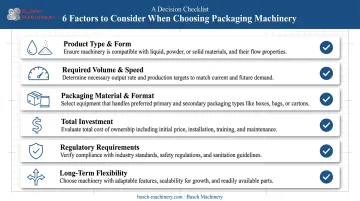
The right machine depends on your product, your production goals, and your budget, not on what's trending or what a competitor bought last year. Before specifying anything, run through these factors:
- Product type and form: liquid, powder, solid, or granular products each demand different fill and handling mechanisms.
- Required volume and speed: units per minute changes everything about which machine class makes sense.
- Packaging material and format: bags, bottles, cartons, and pouches each pair with different equipment.
- Total investment: factor in upfront cost plus ongoing maintenance, parts, and operating expenses, not just the sticker price.
- Regulatory requirements: FDA, HACCP, and GMP rules affect equipment design, cleanability, and documentation needs.
- Long-term flexibility: consider whether the machine can handle future product lines or package changes without a full replacement.
Getting this wrong is expensive. A filler sized for today's volume but not tomorrow's growth, or a machine that can't meet a client's sanitary design standard, turns into a costly do-over.
Busch Machinery brings over 40 years of hands-on engineering experience across the chemical, pharmaceutical, food, and beverage industries. That experience helps match machine specs to actual production needs before you write a purchase order.
Conclusion
Packaging machines drive efficient, compliant manufacturing while keeping costs down across chemical, pharmaceutical, cosmetic, food, and beverage industries. Each of the 10 types covered here serves a distinct purpose. Matching the right machine to your product's form and volume is what actually drives ROI.
Busch Machinery has served as a single-source supplier for over 40 years, making it far simpler to specify, integrate, and maintain a complete packaging line instead of juggling separate vendors for every station.
Frequently Asked Questions
What are the main types of packaging machines?
Packaging machines fall into broad categories: filling, sealing/wrapping, labeling, weighing/inspection, and end-of-line automation. This guide covers 10 specific types within those categories, from fillers and cappers to palletizers.
What is the difference between VFFS and HFFS machines?
VFFS machines form and fill bags vertically, making them ideal for powders and granules. HFFS, or flow wrapping, forms packages horizontally and suits solid products like bars, candy, and baked goods.
How do I choose the right packaging machine for my business?
Base your decision on product type, required production volume, packaging material, and budget. These four factors matter far more than brand popularity or what a competitor is using.
What industries rely most on packaging machinery?
Food and beverage, pharmaceutical, chemical, and cosmetic industries lean heavily on packaging machinery due to strict throughput and regulatory demands. Food alone represents the largest share of overall packaging machinery demand.
How much does a packaging machine cost?
Costs vary widely based on machine type, automation level, and capacity, along with customization and integration needs. Request a tailored quote from Busch Machinery, who can assess your specific product and volume.
Can one machine handle multiple types of packaging?
Yes. Combo systems like a multihead weigher paired with a bagger, or a check weigher integrated with a metal detector, handle multiple functions in one unit. Other machines remain purpose-built for a single task, which is often the better fit for simpler lines.