A palletizer solves this by automatically stacking, arranging, and securing products onto pallets, turning a physically demanding manual task into a controlled, repeatable process. It's become a cornerstone of modern end-of-line packaging automation for exactly that reason.
This guide covers what a palletizer does, how it works, the main types available, their core components, and how to pick the right one for your operation.
Key Takeaways
- Palletizers automate product stacking into stable unit loads, improving handling and shipping efficiency
- Conventional palletizers excel at high-speed, uniform lines, while robotic palletizers adapt to varied SKUs
- Hybrid systems combine conventional speed with robotic flexibility
- Automated palletizing lowers labor costs and injury risk while boosting throughput and consistency
- The best system depends on product type, speed needs, floor space, and budget
What Is a Palletizer and How Does It Work?
A palletizer is automated machinery that stacks, orients, and organizes products, whether boxes, bags, cases, or drums, into a unit load on a pallet. Instead of workers manually placing each item, the machine builds layers in a programmed pattern and lowers or places them onto the pallet in sequence.
The efficiency gain is significant. Moving one consolidated unit load is far faster and cheaper than handling individual items one at a time.
A standard pallet load can carry well over a ton of product, depending on pallet construction and weight distribution. That's why unitizing cargo before shipping saves so much time in transit and storage.
A quick terminology note: you'll sometimes see "unitizer" used alongside "palletizer," though the terms aren't strictly interchangeable. Unitizing refers to combining items into a stable load, which can sit on a pallet or a slip sheet. And a palletizer isn't the same as a depalletizer, which does the opposite job, removing products from an already-loaded pallet.
The Palletizing Process Step-by-Step
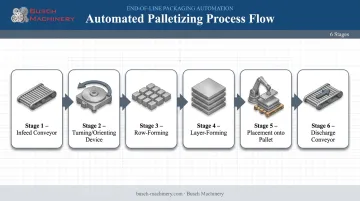
Most palletizing systems follow a similar flow, regardless of whether they're conventional or robotic:
- Infeed conveyor brings products from upstream equipment, such as a case packer, into the machine
- Turning or orienting device rotates items into the correct position for the pattern being built
- Row-forming groups individual items into rows
- Layer-forming arranges completed rows into a full layer matching the pallet footprint
- Placement onto the pallet happens via a stripper plate (conventional) or a robotic arm (robotic), lowering or placing the layer precisely
- Discharge conveyor moves the finished, stacked pallet out for wrapping and shipping
A control panel or PLC runs the entire sequence. When you need to switch to a different box size or stacking pattern, operators typically just load a new program rather than physically reconfiguring hardware, which keeps changeovers fast.
Types of Palletizers
Not every operation needs the same kind of machine. The right type depends heavily on product uniformity, speed requirements, and how often formats change.
Conventional Palletizers
Conventional palletizers use mechanical row and layer formers with a fixed pattern-building sequence. They come in two main configurations:
- Floor-level (low-level) palletizers feed product at roughly 36 inches above the floor. They're easier to install, simpler to maintain, and well suited to moderate-speed operations running uniform products.
- High-level palletizers feed and build layers at an elevated height before lowering the completed stack onto a pallet. The pallet progressively drops as each new layer is added.
This design supports much higher speeds, with some models exceeding 100 cases per minute. It is a common choice for high-volume food, beverage, and fast-moving consumer goods (FMCG) lines.
Robotic Palletizers
A robotic palletizer uses an articulating or linear-motion arm fitted with an end-of-arm tool (EOAT) to pick and place products. Because the arm can be reprogrammed rather than mechanically retooled, it handles mixed SKUs and irregular packaging far more easily than conventional systems.
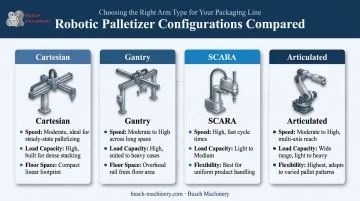
Robotic palletizers typically use one of four common configurations, each with different trade-offs:
- Cartesian – rigid, lower complexity, well suited to heavier loads
- Gantry – a Cartesian variant suspended on overhead rails, useful where floor space is tight
- SCARA – generally faster point-to-point motion, though with less tolerance for unsupported mass
- Articulated – the most flexible for handling irregular orientations, though added complexity can limit ultra-high-speed applications
Hybrid Palletizers
Hybrid palletizers combine conventional row and layer-forming speed with a robotic arm that handles final placement. This setup gives facilities the throughput conventional systems are known for, paired with the flexibility to adjust patterns and product types without a full mechanical overhaul.
Key Components of a Palletizer
Every palletizing line, conventional or robotic, relies on a handful of core components working in sync.
Conventional system components:
- Infeed conveyor
- Turning devices for orientation
- Row and layer-forming stops
- Stripper plate or pusher gate
- Pallet dispenser
- Control panel/PLC
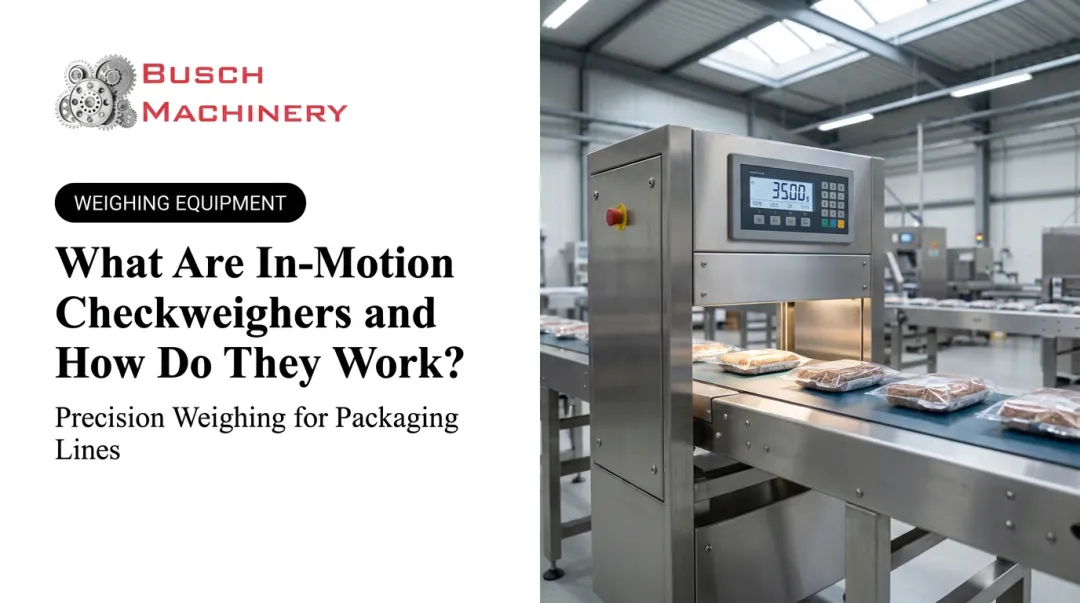
Many lines also integrate quality-control equipment directly alongside the palletizer, particularly in compliance-driven industries like food and pharmaceuticals where package integrity and net-content accuracy matter.
Common additions include:
- Checkweighers
- Metal detectors
- Slip sheet dispensers
Busch Machinery, for instance, offers standalone and combined checkweigher and metal detector systems (its BM-C and BM-GC series) that are frequently specified alongside end-of-line palletizing equipment to catch contamination or weight issues before product ships.
Robotic-specific components center on the end-of-arm tool, which is matched to the product:
- Clamps for rigid cases or cartons
- Forks for bagged or sacked goods
- Vacuum grippers for lightweight or irregular packaging
- Magnetic tools for metal containers or drums
Benefits and Industry Applications of Palletizers
Automated palletizing delivers a fairly consistent set of advantages regardless of industry:
- Reduced labor costs and staffing needs at the end of the line
- Lower injury risk from repetitive lifting and awkward postures
- Higher, more consistent throughput
- Fewer damaged loads thanks to uniform stacking patterns
- Better warehouse space utilization from stable, well-formed unit loads
These gains show up in real data. A Kawasaki Robotics case study tracked a facility running 24/7 on 50-pound bags after it upgraded to a robotic palletizing cell. Annual output climbed from 38,225 to 40,956 pallets, a 7% improvement worth roughly $1.5 million in incremental annual revenue.
Industries That Depend on Palletizers
Certain sectors lean on palletizing more heavily due to volume, regulatory pressure, or both:
- Food and beverage – high-volume lines with strict contamination controls
- Pharmaceutical – packaging and labeling accuracy requirements under CGMP (Current Good Manufacturing Practice) rules
- Chemical – package integrity standards for safe transport
- Cosmetic – varied packaging formats needing flexible handling
- Consumer packaged goods – fast SKU turnover and seasonal packaging changes
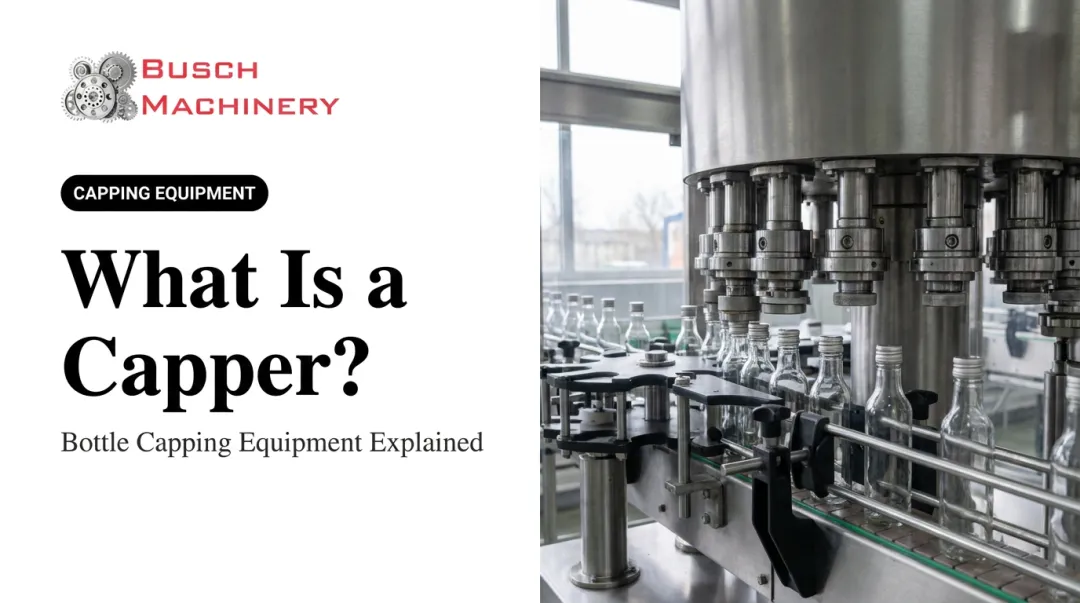
Busch Machinery has worked as a single-source packaging machinery supplier since 1983, helping manufacturers across the chemical, pharmaceutical, cosmetic, and food and beverage industries build complete end-of-line automation. That work connects palletizing with filling, labeling, and weighing systems into one coordinated line rather than a collection of standalone machines.
That connectivity matters because a palletizer rarely operates in isolation. It typically sits downstream of case packers and checkweighers, and feeds directly into stretch wrappers that secure the finished load for shipping. When these systems are specified together, changeovers and troubleshooting get a lot simpler.
How to Choose the Right Palletizer for Your Operation
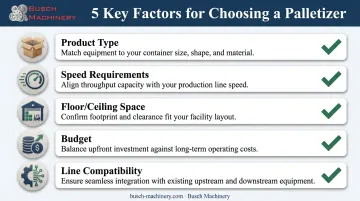
Picking the right system comes down to a handful of practical questions:
- What are you packaging? Product type, weight, and dimensions dictate handling method and EOAT selection
- How fast do you need to run? Throughput requirements separate conventional systems from robotic ones in most cases
- What space do you have? Floor and ceiling clearance affect whether high-level, floor-level, or gantry configurations fit
- What's your budget? Vendor pricing varies enormously by automation level and speed
- Does it need to fit an existing line? Compatibility with upstream case packers or checkweighers affects integration cost
As a quick rule of thumb: conventional palletizers make sense for high-volume, uniform products where speed is the priority. Robotic systems earn their cost when you're running mixed SKUs, frequent format changes, or products that don't fit a fixed mechanical pattern.
With this many variables in play, a conversation with a packaging machinery provider can save costly guesswork. Busch Machinery offers engineering consultation and technical support to match a palletizing solution to your specific throughput and budget, whether that means a standalone machine or a fully integrated end-of-line system.
Frequently Asked Questions
What does a palletizer do?
A palletizer automatically stacks and organizes products onto a pallet in a set pattern, creating a stable unit load that's easier and safer to handle, store, and ship.
How much does a palletizer cost?
Pricing varies widely by type and automation level, with collaborative robotic palletizers generally starting around $100,000 and industrial robotic systems starting near $175,000. Final cost depends heavily on speed, tooling, and integration needs.
What is another name for a palletizer?
Palletizers are sometimes referred to as "unitizers" or "palletizing machines," particularly in contexts where slip sheets or conveyor surfaces replace traditional pallets.
What is a palletizer operator?
A palletizer operator monitors the machine during production, adjusts programmed stacking patterns through the control panel, and troubleshoots issues like misfeeds or pattern errors as they arise.
What industries use palletizers?
Food and beverage, pharmaceutical, chemical, cosmetic, and consumer packaged goods manufacturers all rely on palletizers to handle high-volume or compliance-sensitive end-of-line packaging.
What is the difference between a palletizer and a depalletizer?
A palletizer stacks products onto a pallet to build a unit load, while a depalletizer performs the reverse process, removing products from an already-loaded pallet.