

Heading into 2026, metal detection isn't optional equipment tucked at the end of a line. It's a critical control point that protects consumers, satisfies auditors, and keeps brands off the recall list. Modern systems catch ferrous, non-ferrous, and stainless-steel contaminants that older detectors used to miss, even in wet, salty, or metallized-film products.
This guide breaks down the top metal detector brands serving food manufacturers in 2026, how they differ, and the buying criteria that actually matter, so you can match a system to your product instead of just picking the most familiar name.
TL;DR
- Metal detectors use electromagnetic fields to catch ferrous, non-ferrous, and stainless-steel contaminants before shipment
- CEIA, Mettler Toledo, Loma Systems, Fortress Technology, and Thermo Fisher lead 2026's market with varying sensitivity and integration
- Fit depends on product type, sensitivity needs, and compliance targets like HACCP or ISO 22000
- A supplier like Busch Machinery simplifies sourcing and integration for the whole inspection point, not just the detector
Overview of Metal Detectors in the Food Industry
A food metal detector generates an electromagnetic field across a tunnel or pipe. When metal passes through, it disrupts that field, and the system signals a reject mechanism to pull the product before it reaches a consumer.
Under HACCP, this inspection point often functions as a Critical Control Point (CCP). That means it's a step where control is essential to prevent or reduce a food safety hazard to an acceptable level, according to FDA's HACCP guidelines.
Market growth confirms the stakes. Future Market Insights pegs the global food metal detector market at $5.78 billion in 2025, growing to nearly $8.9 billion by 2035. That's a 4.4% annual growth rate, driven largely by tightening retailer and regulatory scrutiny.
Most plants don't rely on one detector. They stack inspection points:
- Raw material intake — catches contamination before it enters processing
- In-process checkpoints — monitors after grinding, mixing, or forming steps most likely to introduce metal
- Final packaging — the last CCP, positioned after sealing so nothing downstream can reintroduce risk
With the "why" and "where" established, here's how the leading brands stack up against each other.
Top Metal Detectors for the Food Industry in 2026
This list weighs detection sensitivity, reliability in real production environments, industry certifications, and reputation among food manufacturers, not just brand recognition or sticker price. As a multi-brand packaging equipment distributor, Busch Machinery can help source, customize, or integrate any of these systems into your production line.
CEIA
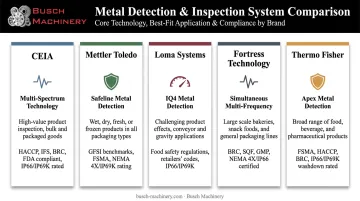
CEIA is an Italian manufacturer widely credited as a pioneer of multi-spectrum metal detection, and its systems run on food and pharmaceutical lines worldwide. Rather than switching between a handful of preset frequencies, CEIA's THS/MS21 platform analyzes the full available frequency spectrum simultaneously through its Auto-Learn process.
That approach compensates aggressively for product effect, meaning the system distinguishes true contaminants from the natural conductivity of salty, wet, or mineral-rich foods far better than single-frequency units.
CEIA doesn't publish one universal minimum particle size. Sensitivity is application- and configuration-specific, so it's worth confirming during a product trial rather than assuming from a spec sheet.
| Feature | Detail |
|---|---|
| Technology | Multi-spectrum simultaneous frequency analysis |
| Best suited for | High-moisture, high-salt, and nutraceutical products prone to false positives |
| Compliance | IP66/IP69K washdown ratings, HACCP and GMP compliant design, ISO 9001-manufactured, USDA-certified construction on select models |
Mettler Toledo (Safeline)
Mettler Toledo's Safeline line pairs metal detection with the option to add X-ray inspection for glass, stone, and dense plastic contaminants, giving processors a path to broader inspection coverage as their compliance needs grow. The flagship Profile Advantage detector uses Multi-Simultaneous Frequency technology combined with Product Signal Suppression software.
That combination is built specifically for tricky applications: wet products, hot-fill lines, chilled or cooling conveyors, and metalized-film packaging. Mettler states the software can virtually eliminate false rejects caused by product effect in these conditions, a claim that's worth validating with your own product samples before committing.
| Feature | Detail |
|---|---|
| Technology | Multi-simultaneous frequency detection, with optional X-ray inspection as a separate system |
| Best suited for | High-end packaged food lines needing multi-contaminant inspection |
| Compliance | IP65, IP69, and IP69K configurations available depending on model and conveyor setup |
Loma Systems
Loma, a UK-based food safety specialist, has spent over three decades focused specifically on meat, dairy, and snack production lines. Its IQ4 range runs on what the company calls true Variable Frequency technology paired with enhanced Auto-Learn capabilities, and the IQ4M model steps up to multi-spectrum detection for tougher applications.
Where Loma stands out is hygienic build quality. Sloped surfaces, sealed apertures, and easy-clean mechanics are designed for plants running frequent washdowns. The IQ4 RUN-WET conveyor carries full IP69 protection, while the legacy INSIGHT HDE head is rated IP69K/PW12.
| Feature | Detail |
|---|---|
| Technology | Variable Frequency technology with multi-spectrum detection on IQ4M models |
| Best suited for | Processed foods, meat, dairy, and snack production |
| Compliance | IP69/IP69K washdown ratings; test pieces and validation tools supplied for HACCP documentation |
Fortress Technology
Fortress, a North American manufacturer, built its reputation on high-sensitivity conveyor and pipeline detectors for tough food applications. Its Stealth Meat Pump detector uses Digital Signal Processing Technology purpose-built for high-viscosity meat, paste, and sauce lines where product consistency varies constantly.
Fortress also leans into combination systems. The Raptor Combination System merges metal detection and checkweighing on a single conveyor with one shared operator interface, cutting the footprint and simplifying line control for bakery and bulk producers.
| Feature | Detail |
|---|---|
| Technology | Digital Signal Processing tuned for viscous and pipeline products |
| Best suited for | Bakery, meat, and bulk or pipeline product inspection |
| Compliance | IP65 rating on the Raptor Combination System, IP69K on Stealth Pipeline detectors |
Thermo Fisher Scientific
Thermo Fisher's Sentinel series brings the company's broader scientific-instrumentation pedigree to food and pharmaceutical production. Sentinel Multiscan systems can scan combinations of up to five user-selectable frequencies, with the Sentinel 5000 covering a 50 to 1,000 kHz range for flexibility across product types.
For large-scale processors, the bigger draw might be data. Sentinel units offer secure login, statistics collection, and event logging designed to support audit-ready traceability records, useful when a customer or regulator asks for proof of inspection history.
| Feature | Detail |
|---|---|
| Technology | Multi-frequency detection (up to 5 selectable frequencies) with integrated data logging |
| Best suited for | Large-scale processors needing traceability and audit-ready reporting |
| Compliance | IP69K rating on the Sentinel detector unit (checkweigher ratings vary by model) |
How We Chose the Best Metal Detectors
Picking a metal detector by brand name alone is a common and costly mistake. Our evaluation weighed four factors:
- Detection sensitivity: how well the system distinguishes true contaminants from product effect across wet, dry, and mixed products
- Reliability — build quality, ingress protection ratings, and performance consistency in washdown or high-throughput environments
- Industry certifications: HACCP, GMP, and ISO alignment that support audit readiness
- Market reputation — feedback from processors running these systems day to day, not just manufacturer claims
Here's the mistake we see most often: prioritizing upfront price over product-specific detection performance. A cheaper detector that generates frequent false rejects, or worse, misses real contaminants, costs far more in downtime, wasted product, and recall exposure than the initial savings.
Sensitivity, throughput, and compliance aren't abstract specs. They directly shape:
- Recall risk: under-sensitive detection is a liability waiting to surface
- Downtime — over-sensitive settings that trigger constant false rejects slow your whole line
- Return on investment: the right-sized system pays for itself through fewer stoppages and stronger compliance standing
This is exactly where a supplier who understands full production lines, not just individual machines, helps you avoid a costly mismatch. Busch Machinery has worked as a single-source packaging machinery supplier since 1983, and that line-level perspective helps match detector specs to real throughput and compliance requirements rather than a generic spec sheet.
Conclusion
There's no single "best" metal detector for the food industry in 2026. The right system is the one matched to your product's moisture content, salt level, line speed, and the compliance framework you're operating under, whether that's HACCP, SQF, or ISO 22000.
Before finalizing a purchase, weigh long-term performance and total cost of ownership, not just the sticker price. A detector that runs reliably for a decade with minimal false rejects beats a cheaper unit that needs constant recalibration.
If you're ready to evaluate options for your production line, Busch Machinery's engineering team can walk through your specific requirements and help you select and integrate the right metal detection setup. Reach out for a consultation and get equipment matched to your actual line, not a generic recommendation.
Frequently Asked Questions
How do you validate a metal detector in the food industry?
Plants pass certified ferrous, non-ferrous, and stainless-steel test pieces through the detector at shift start, after maintenance, and during changeovers. This confirms the detection and reject mechanism still work before production continues.
Can metal detectors detect metal in food products?
Yes. They detect ferrous, non-ferrous, and stainless-steel contaminants by sensing disruptions in an electromagnetic field as product passes through. Detection ability varies by metal type, particle size, shape, and where the fragment sits within the product.
Should food products be inspected with metal detectors?
Yes. Metal detection is a standard HACCP control point on most production lines. It protects consumers from injury and brands from costly recalls and reputational damage.
What is the FDA limit for metal detection in food?
The FDA doesn't set one universal numeric limit for metal detectors, only requiring "effective measures" against contamination. Guidance notes objects under 7mm rarely cause serious injury; limits are set per product and system.
What is the difference between multi-frequency and multi-spectrum metal detectors?
Multi-frequency systems switch between a limited set of preset frequencies depending on the product. Multi-spectrum systems analyze the full frequency range simultaneously, improving accuracy and cutting false rejects on tricky wet or salty products.
How often should food metal detectors be calibrated?
Best practice is testing with certified test pieces every shift, after maintenance, and at changeovers. Full manufacturer calibration is typically annual, though your HACCP or SQF plan should set the exact schedule.