Introduction
Packaging used to be simple: wrap the product, ship it, done. Not anymore.
Today's food and beverage packaging has to protect contents, extend shelf life, meet strict labeling laws, and still look good enough to grab attention on a crowded shelf. The global food packaging market reflects that pressure. Fortune Business Insights values it at $533.22 billion in 2025, projecting growth to $930.89 billion by 2034.
The challenge for manufacturers is real: how do you satisfy regulators, meet sustainability targets, and keep costs manageable, without sacrificing quality?
This guide breaks down the packaging types, materials, machinery, and safety standards you need to know to make smarter packaging decisions for your product line.
Key Takeaways
- Food packaging serves four core functions: containment, protection, convenience, and communication
- PET and HDPE dominate plastic packaging; glass and metal offer superior barrier protection
- Primary, secondary, and tertiary packaging each require different equipment and handling strategies
- FSSC 22000 certification and FDA labeling rules are separate, non-interchangeable compliance requirements
- Automated filling, weighing, and end-of-line equipment directly impact throughput and product waste
What Is Food and Beverage Packaging and Why It Matters
Food and beverage packaging is the full system of materials and structures that contains, protects, and presents a consumable product from the production line to the consumer's hand. It functions as an engineered system built to handle several jobs at once.
Physical and barrier protection comes first. Packaging shields contents from contamination, moisture, oxygen, and physical damage during handling, shipping, and storage. Without this barrier, products degrade before they ever reach a shelf.
Shelf-life extension is where material science gets interesting. Modified atmosphere packaging (MAP), which alters the gas mix surrounding a product, can slow spoilage considerably. A UC Davis plum trial found that unpackaged fruit lost about 6% of its fresh weight after 60 days at 0°C, compared to just 0.1% to 0.3% weight loss with MAP liners.
Researchers noted the benefit held for up to 45 days before quality issues appeared. That's a useful reminder that MAP isn't a universal fix. It has to be validated for each product.
Packaging also carries compliance obligations. Regulators require ingredient lists, nutrition facts, and allergen disclosures on virtually every packaged food product sold in the U.S.
Finally, there's the marketing and convenience function. Packaging influences buying behavior more than most manufacturers realize. Ipsos surveyed 2,002 U.S. adults in 2018 and found that 72% said package design often influences their purchase decisions, and 67% said the packaging material itself plays a role.
That survey covered products broadly, not food alone, but the takeaway still applies: design choices carry commercial weight.
Types of Food and Beverage Packaging
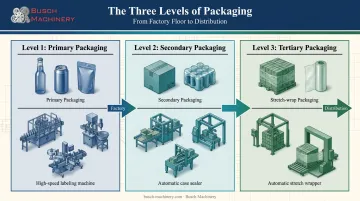
Packaging is generally organized into three levels, each with a distinct job in getting product from the factory floor to the consumer's cart. Common structural formats across these levels include:
- Bottles, cans, and cartons
- Bags, pouches, and boxes
- Trays, pallets, and wrappers
Primary Packaging
Primary packaging is the layer in direct contact with the product itself. Think bottles, cans, pouches, and cartons. This layer does the heaviest lifting for product protection and shelf-life since it's the only barrier between the product and the outside world.
Secondary Packaging
Secondary packaging groups primary units together for handling and retail display. Corrugated cases and shrink-wrapped multipacks fall into this category. It doesn't touch the product directly, but removing it shouldn't change the product's characteristics.
Tertiary Packaging
Tertiary packaging handles bulk logistics: pallets, stretch wrap, and transport containers used for warehousing and distribution. This layer protects products during long-haul shipping and large-scale handling.
Each level typically requires different automated equipment to assemble efficiently:
- Primary: Filling, capping, and labeling machines
- Secondary: Case erectors, case packers, and case sealers
- Tertiary: Palletizers and stretch wrapping systems
Busch Machinery supplies equipment across all three levels, from primary fillers and cappers to secondary case packers, palletizers, and stretch wrappers for tertiary logistics.
Common Materials Used in Food and Beverage Packaging
Material selection isn't arbitrary. It depends on the product being packaged, required shelf life, budget, and sustainability goals. Here's how the major categories stack up.
Plastic
PET (polyethylene terephthalate) is the most widely used plastic for beverage bottles. It's lightweight, shatter-resistant, and recyclable, which makes it a natural fit for soft drinks and water. HDPE (high-density polyethylene) is the go-to choice for milk jugs and other dairy containers, prized for its rigidity and durability.
Technical recyclability and actual recovery aren't the same thing, though. EPA data from 2018 put U.S. recovery rates at roughly 29% for both PET bottles and natural HDPE containers, meaning most material still isn't making it back into the recycling stream.
Glass
Glass is chemically inert, so it doesn't interact with the product inside. That makes it the top choice for wine, sauces, and premium beverages where flavor preservation matters most. The trade-off is weight and fragility, which drives up shipping costs and breakage risk. Glass also tends to have a lower U.S. recovery rate than paperboard.
Metal
Aluminum and steel cans deliver superior barrier protection against light and oxygen, making them a strong choice for carbonated beverages and canned foods. They're also highly recyclable: aluminum beverage cans hit a 43% recycling rate for cans shipped in 2023, while steel containers reach roughly 58% end-of-life recovery.
Paper and Paperboard
Paperboard cartons and corrugated boxes are renewable and widely recycled, making them a solid choice for secondary packaging. Plain paper alone isn't enough for liquid products, though, since it lacks barrier and heat-sealing properties.
Manufacturers add wax or polyethylene coatings to handle moisture, grease, and gas resistance. Creasing and folding during converting can crack those coatings, though, reducing their effectiveness.
The Role of Packaging Machinery in Food & Beverage Production
Even the best material or design is only as good as the equipment that puts it to work. A package has to be filled, sealed, weighed, and labeled accurately and hygienically at production speed, and that's where machinery selection becomes critical.
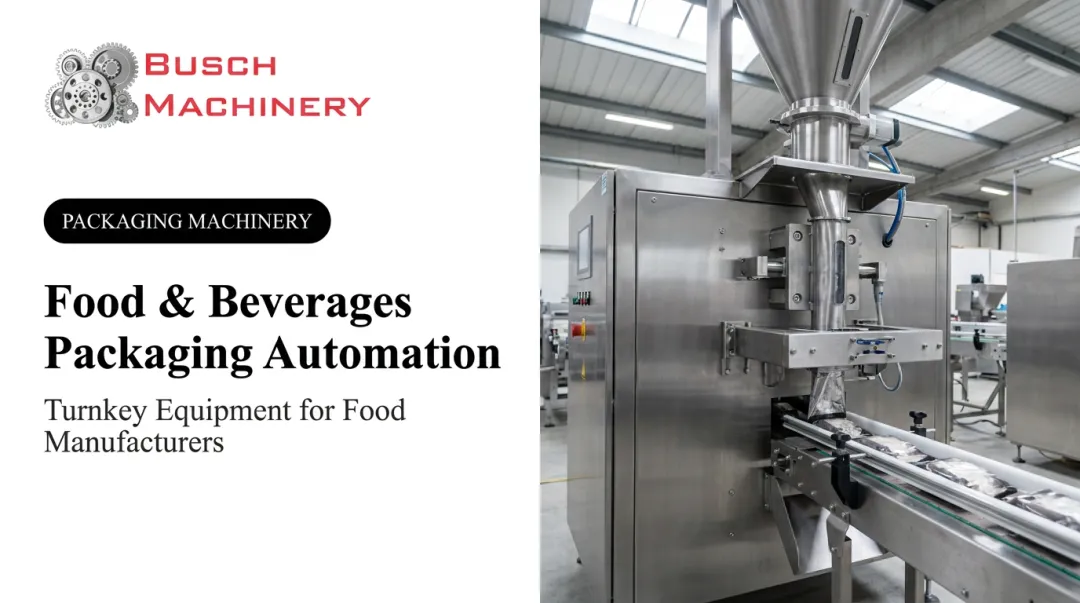
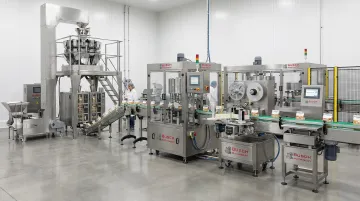
A typical food and beverage packaging line relies on several core equipment categories:
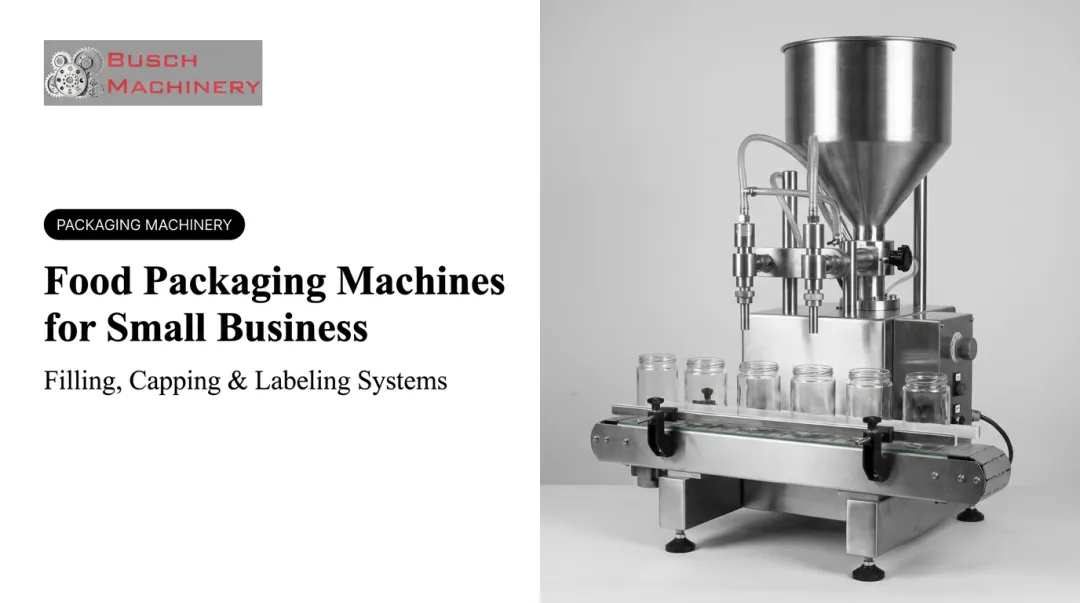
- Filling machines for liquids, powders, granules, and pastes
- Capping and labeling systems to seal containers and apply required information
- VFFS (vertical form-fill-seal) machines for bags and pouches
- Multihead weighers for accurate portioning
- Checkweighers to verify fill weights before shipping
- Metal detectors to catch contamination before product reaches consumers
Automation across these categories reduces manual labor, increases throughput, and minimizes product giveaway through precision weighing. Giving away even a fraction of an ounce per unit adds up fast across a high-volume production run.
This is exactly the space Busch Machinery has worked in since 1983. As a single-source supplier serving the Chemical, Pharmaceutical, Cosmetic, Food, and Beverage industries, the company provides filling, labeling, capping, weighing, and end-of-line automation equipment.
Engineering support helps manufacturers select the right equipment for their budget and production goals. Whether a business needs a single semi-automatic machine or a fully integrated turnkey line, that kind of applications expertise matters when equipment decisions directly affect margins.
Food Safety Standards and Regulatory Compliance
Packaging compliance runs on two separate tracks: voluntary certification, such as programs recognized by the Global Food Safety Initiative (GFSI), and mandatory federal regulation. Confusing the two can create real compliance risk for manufacturers.
FSSC 22000 is a GFSI-recognized certification built on ISO 22000 plus sector-specific prerequisite programs. GFSI announced recognition of FSSC 22000 Version 6 in August 2024, confirming it meets globally accepted food safety benchmarking requirements. Packaging manufacturers use it to verify their food safety management systems, but certification doesn't replace regulatory approval.
FDA labeling requirements are non-negotiable for any product sold in the U.S. Manufacturers must disclose:
- Allergens among the nine major categories, including milk, eggs, and tree nuts
- Nutrition facts on virtually all packaged foods and drinks
- Ingredients listed in descending order by weight
Good Manufacturing Practices (GMP) round out the compliance picture, covering plant hygiene and equipment sanitation. These practices, along with food-contact material safety requirements, help prevent contamination and support traceability throughout the supply chain, from raw packaging material to finished product on the shelf.
The 4 C's of Packaging Design
Packaging designers often lean on a simple framework to evaluate whether a solution actually works: the 4 C's.
- Containment: holds the product securely without leaks, spills, or breakage
- Protection: guards against damage, contamination, and environmental exposure
- Convenience: covers usability, portion control, and resealability for the end user
- Communication: conveys branding, nutrition facts, and required regulatory information
Before finalizing any packaging design, running it through these four pillars helps confirm it meets both functional requirements and marketing goals.
Skip one, and you risk a package that looks great but fails on the shelf, or one that protects the product but never gets picked up in the first place.
Frequently Asked Questions
What is the FSSC 22000 packaging standard?
FSSC 22000 is a GFSI-benchmarked certification scheme for food safety management systems, covering packaging manufacturing among other sectors. It combines ISO 22000 with sector-specific prerequisite programs.
Which plastic is commonly used for food and beverage packaging?
PET is the most widely used plastic for beverage bottles because it's lightweight, shatter-resistant, and recyclable. HDPE is the standard choice for dairy and juice containers.
What are the 4 C's of packaging?
The 4 C's are Containment, Protection, Convenience, and Communication. Together, they form a framework designers use to evaluate whether a package meets functional and marketing needs.
What are the 7 types of packaging?
Common structural formats include bottles, cans, cartons, bags and pouches, boxes, trays, and pallets or wrappers. These formats appear across all three packaging levels.
What is the difference between primary and secondary packaging?
Primary packaging touches the product directly, like a bottle or can. Secondary packaging groups those primary units together for handling and retail display, such as a shrink-wrapped multipack.
How do I choose the right packaging machinery for my product?
Equipment choice depends on your product type, required throughput, and budget. Busch Machinery's engineering team can help match the right filling, weighing, or end-of-line equipment to your production goals, whether you need a single machine or a full turnkey line.