Manufacturers across food, pharma, cosmetics, and chemicals are feeling this squeeze harder than ever. Skilled labor is scarce, SKU counts keep climbing, and e-commerce has forced brands to rethink case formats and shipping presentation entirely. According to PMMI's 2025 workforce report, 95% of end users say they struggle to find skilled operators and technicians.
This article breaks down what EOL automation actually is, the equipment involved, the benefits worth quantifying, and how to pick a partner who won't leave you with a patchwork line.
Key Takeaways
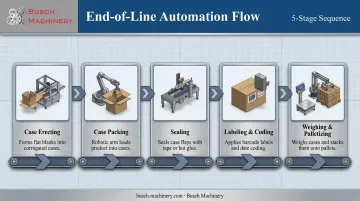
- EOL automation covers case erecting, packing, sealing, labeling, weighing, and palletizing
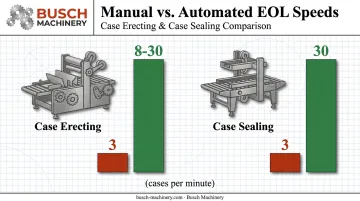
- Automated case erecting runs 8-30 cases/minute versus roughly 3 cases/minute manually
- Typical payback windows range from 6 months to 3 years, depending on volume and labor costs
- Single-source suppliers reduce integration headaches compared to multi-vendor "Frankenstein" lines
- Scalable, semi-automatic entry points exist for smaller operations before full automation
What Is End-of-Line Packaging Automation?
End-of-line (EOL) packaging is the final production stage where finished, individually packaged products get grouped, sealed, labeled, and prepared for shipment. Think secondary and tertiary packaging: cases, cartons, pallets, and shrink-wrapped loads, not the primary fill or cap step.
Manual EOL relies on workers hand-forming boxes, taping seals, and stacking pallets. Automated systems replace those repetitive tasks with robotics, sensors, and conveyors working in sync. The line doesn't stop moving to wait on a person.
Where EOL automation fits:
Packaging World's industry primer notes that EOL operations can represent 20%-30% of a total production line, starting once products are already in their individual package format. That's a trade-publication estimate rather than a validated benchmark, but it lines up with what plant managers see on the floor: the back end of the line is where labor gets concentrated.
Core EOL tasks include:
- Case erecting and forming
- Case packing and sealing
- Labeling, coding, and batch marking
- Weight verification and quality inspection
- Palletizing and stretch wrapping
Rising SKU counts compound this labor pressure. More product variations mean more changeovers, more manual adjustments, and more chances for error, pushing manufacturers to automate further down the line rather than stopping at filling and capping.
Key Equipment and Components of EOL Automation Systems
A complete EOL system combines multiple machines into one coordinated set of equipment, each handling a specific task, tied together so product flows without a hand ever touching a box.
Case Erectors and Case Formers
These machines pull flat cardboard blanks, form them into cartons, and seal the bottom, all in seconds. Busch Machinery's EC-801N automatic case erector and bottom sealer integrates a conveyor for continuous transport, while the EC-812S semi-automatic case former offers foot-pedal, hands-free operation for smaller-scale lines that aren't ready for full automation yet.
Case Packing and Sealing Equipment
Case packers place products into cartons in organized patterns, robotically or mechanically, depending on product fragility and throughput needs. Sealers then close the box.
Busch Machinery's tape-based sealer lineup spans nine models, from the semi-automatic BM-701W to the fully automatic, random-size BM-705A, which handles cartons from 6" to 26" long at 75 feet per minute. Hot-melt glue sealing is available as an option on select models for tamper resistance.
Labeling and Coding Systems
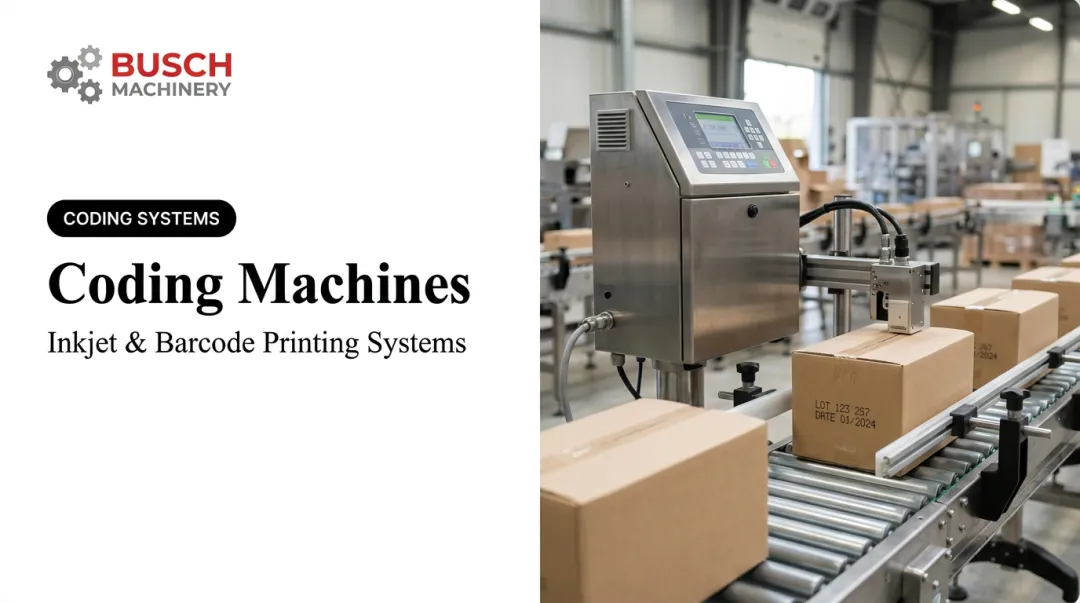
Automated labelers apply barcodes, lot numbers, expiration dates, and regulatory text with consistency a human hand can't match at speed. For pharma and food manufacturers facing traceability requirements, this isn't optional. A misprinted date code can trigger a recall.
Weighing, Checkweighing, and Inspection Equipment
Multihead weighers and checkweighers verify that every case or container hits its declared fill weight, catching underfills before they become compliance issues and overfills before they eat into margin. This is one of Busch Machinery's core specialties for food, pharma, and chemical manufacturers navigating NIST and FDA net-content requirements.
Metal detectors, often integrated right alongside checkweighers, add a final inspection checkpoint before product ships.
Palletizing and Stretch Wrapping
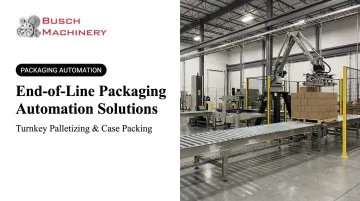
Robotic and gantry palletizers stack cases in computer-optimized patterns for maximum pallet stability. Stretch wrappers then secure the load for transport, reducing shifting and damage in transit.
Conveyor and Integration Systems
Conveyors are the connective tissue linking every piece of EOL equipment into one continuous flow. Piece together erectors, packers, and palletizers from five different vendors, and you get a fragmented, "Frankenstein" system: mismatched controls, conflicting speeds, and an engineering headache every time something breaks.
A single-source integrator avoids that mess by designing the whole flow together from the start.
Benefits of Automating Your End-of-Line Packaging
Throughput and Speed
The speed difference is not subtle. Manual case erecting runs about 3 cases per minute, while automated erectors handle 8 to 30 cases per minute, depending on the model and configuration. Sealing shows a similar gap, with automatic systems reaching up to 30 cases per minute versus roughly 3 for manual taping.
Cost Savings and ROI
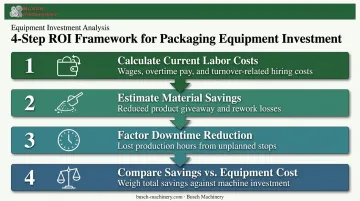
Payback windows vary by application, but published ranges commonly fall between 6 months and 3 years. High-volume, labor-heavy operations tend to land on the shorter end. A useful ROI model factors in:
- Labor savings from reduced headcount on repetitive tasks
- Material savings from tighter fill-weight control
- Reduced downtime from fewer manual bottlenecks
- Lower error/rework costs
Precision checkweighing plays a direct role in that material savings line. In one documented case, a food manufacturer cut product giveaway by 2-3% after installing better checkweighing and monitoring — a margin that adds up fast at scale and directly supports fill-weight compliance under FDA and NIST net-content rules.
Safety and Scalability
Removing manual lifting and repetitive taping/sealing motions reduces exposure to musculoskeletal strain, one of the most common injury categories in packaging environments. OSHA specifically recommends mechanical handling devices as an engineering control for this risk.
Automated systems also adapt to seasonal spikes and shifting SKU mixes without adding shifts. That flexibility matters more every year as e-commerce fulfillment demands smaller, more varied case formats on shorter lead times.
Industries That Benefit Most from EOL Automation
Food and beverage manufacturers need hygienic handling, high-volume throughput, and consistent case presentation. Automated checkweighing and metal detection combine to catch contamination and fill-weight issues before product leaves the plant.
Beyond food and beverage lines, pharmaceutical and chemical manufacturers face strict regulatory demands. Automated labeling and coding support traceability requirements like the Drug Supply Chain Security Act. Sealed, controlled environments further reduce contamination risk in sterile production.
Outside regulated industries, cosmetic, nutraceutical, and light industrial manufacturers deal with constantly varied package sizes and premium brand presentation. Flexible, reprogrammable EOL equipment handles frequent changeovers without sacrificing the polished look retail customers expect.
Signs It's Time to Automate and How to Calculate ROI
There's no single universal volume threshold. Vendor guidance ranges from roughly 300 to 1,000 boxes per day before automation pencils out. What matters more is your specific labor cost, shift structure, and SKU mix.
Operational signs you're overdue:
- Chronic labor shortages or high turnover in packaging roles
- Case packing or sealing can't keep pace with upstream production
- Inconsistent seal quality or label placement causing rejects
- Rising repetitive-motion injury reports
- Manual palletizing creating forklift traffic and floor congestion
Building a simple ROI framework:
- Calculate current loaded labor cost for EOL tasks (wages, overtime, turnover/training costs)
- Estimate material savings from reduced giveaway and rework
- Factor in downtime reduction from eliminating manual bottlenecks
- Compare total annual savings against equipment and installation cost
Vendor-published payback estimates run from 6 months to 3 years. Treat those as starting points, not guarantees, since your actual return depends on your specific line, not an industry average. Busch Machinery's applications engineering team can pressure-test these numbers against your real production data before you commit to equipment.
Choosing the Right End-of-Line Automation Partner
Piecing together case erectors from one vendor, sealers from another, and palletizers from a third sounds cost-effective until controls don't talk to each other and every service call means calling three companies. That fragmented approach creates the exact "Frankenstein" system problem manufacturers are trying to escape.
What to look for in a partner:
- A single-source supplier who can integrate filling, labeling, weighing, and EOL equipment as one coordinated system
- An established track record: Busch Machinery, for example, has operated as a packaging machinery supplier since 1983 and holds BBB accreditation
- Engineering support that can troubleshoot across the whole line, not just one machine
- Phased implementation options, starting with a semi-automatic case former and scaling to full robotic case packing as volume grows
Starting small doesn't mean starting over later. A supplier who understands your full production picture can design equipment now that scales without a rebuild in two years.
Frequently Asked Questions
What is end of line packaging?
End-of-line packaging covers the final production stage: case packing, sealing, labeling, and palletizing before product ships. It happens after primary filling and capping are complete.
What equipment is included in end-of-line automation?
Core equipment includes case erectors, case packers, sealers, labelers, checkweighers, palletizers, and stretch wrappers, all connected through a conveyor network.
How long does it take to see ROI from EOL automation?
Payback windows typically range from 6 months to 3 years. Higher-volume operations with significant labor costs tend to see faster returns than lower-volume, complex lines.
Can EOL automation handle multiple product sizes and types?
Yes. Modern case packers and sealers, like Busch Machinery's random-size BM-705A, use reprogrammable settings to switch between carton sizes quickly without manual retooling.
Is EOL automation only worthwhile for large manufacturers?
No. Semi-automatic entry points, like foot-pedal case formers, give smaller operations an affordable starting point that can scale as production volume grows.
Will automating end-of-line packaging eliminate jobs at my facility?
Typically not. Automation shifts workers away from repetitive lifting and taping toward higher-value roles like quality control, equipment oversight, and line troubleshooting.