Introduction
An in-motion checkweigher can verify a product's weight thousands of times per shift without ever stopping the conveyor belt. That's the whole point: catch weight errors at production speed, not after the fact.
These systems have become standard equipment across food, pharmaceutical, and chemical manufacturing. Some models process up to 700 packages per minute, though real-world throughput typically runs 100 to 300 packages per minute depending on package length, according to Thermo Fisher's checkweighing guide.
Most operators know checkweighers exist. Fewer understand the internal weighing, control, and rejection logic driving that accuracy — which leads to poor equipment selection and misdiagnosed line issues.
This guide breaks down exactly how in-motion checkweighers work, stage by stage.
TL;DR
- In-motion checkweighers weigh products in real time on a moving conveyor, no stopping required
- Three zones handle the job: infeed, weighing conveyor (load cells), and outfeed/rejection
- Mechanical, air, or drop rejectors automatically flag and remove out-of-tolerance products
- Systems integrate with PLCs and upstream fillers, sending correction signals that cut giveaway and rework
- Food, pharma, chemical, and agricultural lines rely on these systems for 100% inspection and compliance
What Is an In-Motion Checkweigher?
An in-motion checkweigher is a scale built directly into a conveyor line. It captures the weight of each product as it passes over the weighing section, no pausing, no manual handling.
That distinction matters. Manual spot-checks or static bench scales only sample a fraction of output. On a line running hundreds of units per minute, spot-checking misses far more than it catches. Underweight or overweight items slip through, creating compliance risk and customer complaints.
In-motion checkweighing solves this by inspecting every single unit. Mettler-Toledo notes that dynamic checkweighing systems can automatically check 100% of products produced on an equipped line, not a sample, but the whole run.
Checkweigher vs. Catchweigher: What's the Difference?
The terms get used interchangeably, but they're not the same:
| Term | Definition |
|---|---|
| Checkweigher | Compares each item against a single target weight and tolerance range, then accepts or rejects it |
| Catchweigher | A broader category (per OIML's classification) that sorts products into multiple weight-based groups, not just accept/reject |
A checkweigher is technically a subtype of catchweigher, built specifically for accept/reject decisions against one setpoint.
Common Types You'll Run Into
- Standard conveyor checkweighers: General-purpose units for mid-speed lines
- High-speed checkweighers: Built for high-volume packaging where dwell time on the scale is minimal
- Combination units: Pair checkweighing with metal detection in a single pass
Combination systems are worth a closer look if your line needs both weight verification and contamination screening. Busch Machinery, for instance, offers combined check weigher and metal detector models, including the BM-GC212, BM-GC215, BM-GC315, and BM-GC320.
These units catch ferrous contaminants as small as 1.0mm and stainless steel down to 2.5mm, all while verifying weight in the same pass. Sourcing checkweighers alongside multihead weighers and metal detectors from one supplier also simplifies integration when you're building or upgrading a full line.
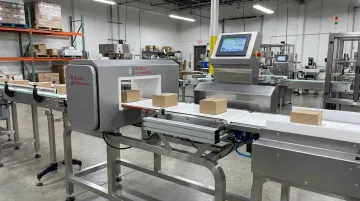
These configurations show how flexible in-motion checkweighing has become, but the core function hasn't changed. Even as vision and AI-based inspection tools advance, weight verification stays central. Net-quantity accuracy is often a regulatory requirement that visual inspection alone can't satisfy.
How Does an In-Motion Checkweigher Work?
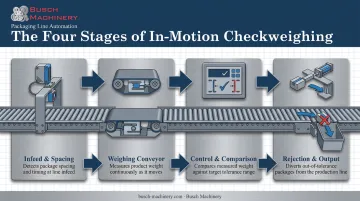
The process happens across three physical zones and a continuous data loop. Each stage feeds the next, and the whole sequence, from product entry to accept/reject decision, completes in milliseconds.
Initiation
Products enter the infeed conveyor first. Its job is spacing: making sure each item crosses the scale individually, with a clean gap before and after.
This stage runs fully automated once the line is up. Sensors or photo eyes detect product position and timing, adjusting infeed speed slightly to correct spacing before items reach the weigh table.
Common bottleneck: if two products bunch together, or a spacing sensor misfires, the system may register a combined weight as a single reading. That triggers an incorrect rejection, and it's one of the most frequent causes of unexplained reject-rate spikes on a line.
Core Operation
As the product crosses the weighing conveyor, load cells underneath detect the applied pressure and convert it into an electrical signal. Here's the simplified sequence:
- Mechanical strain from the product's weight changes the load cell's electrical resistance
- That shift produces a small voltage signal (measured in mV/V)
- The signal is amplified
- An analog-to-digital converter transforms it into a digital value
- The control unit processes that digital reading
Belt speed, product weight range, and package length all affect how much time a product actually spends on the weigh table, which directly limits achievable accuracy.
Anritsu's KW6203AF03 model, for example, lists a maximum accuracy of ±0.02g (3 sigma) across a 2–600g range at speeds up to 400 products per minute, though those maximums don't necessarily occur together on the same run.
Regulation / Control
The control unit takes that digital weight and compares it against a pre-programmed target and tolerance range. This is where the accept/reject logic actually lives.
Advanced systems go a step further. Instead of just flagging individual units, they track weight trends over time and send correction signals upstream to the filler.
- Unit-level control: catches individual out-of-spec items immediately
- Process-level control: catches slow drift (like a filler head trending underweight) before it produces a whole batch of rejects
Without continuous monitoring and data logging, that kind of drift can go unnoticed for hours. By the time someone catches it manually, you're looking at a large batch already out of spec, an expensive problem to fix after the fact.
Output / Result
At the outfeed conveyor, the system executes its accept or reject decision automatically. No operator input needed.
Rejection method depends heavily on product type:
| Rejector Type | Best Suited For |
|---|---|
| Air jet / blast | Small, lightweight, high-speed items |
| Pneumatic pusher arm | Mid-weight packages, general use |
| Flipper/diverter | Boxes, thick bags |
| Drop-down gate | Products that shouldn't be impacted |
| Full line stop | High-value or fragile industrial goods |
Every rejected and accepted weight gets logged. That data feeds compliance reports, batch records, and line performance dashboards, giving quality teams a paper trail without extra manual work.
Where Are In-Motion Checkweighers Used?
Checkweighers typically sit near the end of a packaging line, right after filling or bagging and before labeling or palletizing. That positioning catches weight errors before product leaves the facility.
They perform best on high-speed, high-volume lines that need 100% inspection rather than sampling. That covers:
- Food and beverage packaging
- Pharmaceutical production
- Chemical manufacturing
- Agricultural and cosmetic packaging
Rejection setup varies by product. Lightweight, fast-moving items like snack packs or pill bottles usually pair with air or push rejectors. Heavier or fragile goods, think drums or glass jars, tend to rely on diverters or full-stop rejection instead.
Building a Full-Line Setup
Checkweighers rarely operate in isolation. A typical end-of-line sequence looks like this:
Conveyors → checkweigher/metal detector → labeler or print-and-apply → case erector/sealer/packer → palletizer → pallet wrapper
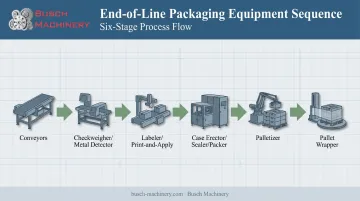
Manufacturers across chemical, pharmaceutical, food, and cosmetic sectors commonly pair checkweighers with this kind of complementary automation.
Busch Machinery, a single-source supplier since 1983, supports integration across this whole sequence, from the conveyors feeding the checkweigher to the labelers, case handling, and robotic palletizing at the line's end. Working with one source for these pieces cuts down on compatibility headaches when equipment needs to talk to each other.
Conclusion
An in-motion checkweigher's real value comes from the continuous loop of weighing, comparing, and correcting that happens behind the scale, thousands of times a shift, without slowing anything down.
Understanding that loop changes how you shop for one. Instead of asking "what's the price," ask about load cell type, rejection mechanism, and how well the system integrates with your existing line. Those factors determine whether you get accurate, reliable inspection or a bottleneck disguised as quality control.
If you're weighing options for your production line, Busch Machinery's applications engineering team can help match checkweighing equipment to your specific throughput, product range, budget, and integration needs.
Frequently Asked Questions
What is the cost of a checkweigher conveyor system?
Pricing varies widely based on speed, load cell precision, and rejection mechanism. Request a quote based on your specific product line and throughput needs.
What is a checkweigher used for?
It verifies package weight for quality control, prevents product giveaway, and supports regulatory compliance in industries like food and pharmaceutical. It also generates the batch data regulators often require.
What is the difference between a checkweigher and a catchweigher?
A checkweigher checks against one target tolerance for a simple accept/reject decision. A catchweigher is the broader category and can sort products into multiple weight-based groups or grades.
What is the principle of a checkweigher?
Load cells convert applied weight into an electrical signal, which gets amplified and converted to a digital reading. That digital value is then compared against a preset target and tolerance range.
How accurate are in-motion checkweighers?
Accuracy depends on load cell quality, belt speed, and calibration frequency. Well-maintained systems can hit tight tolerances (some models rated to ±0.02g) even at several hundred products per minute.
Can in-motion checkweighers integrate with other packaging equipment?
Yes. Modern checkweighers connect with PLCs and upstream fillers to send real-time correction signals, allowing the filler to self-adjust before a full batch drifts out of spec.