But when a coding machine misfires, the results are anything but invisible. Illegible codes, missing batch numbers, and mismatched dates trigger retailer chargebacks, regulatory holds, and in worst-case scenarios, full product recalls. Food, pharma, and chemical manufacturers all live with this risk daily.
This guide breaks down how coding machines work, the four major marking technologies, where they're used across industries, and how to choose the right system for your packaging line.
Key Takeaways
- Coding machines print dates, batch codes, and barcodes directly onto products for full traceability.
- Four technologies dominate the market: CIJ, TIJ, laser marking, and TTO.
- Substrate type, line speed, and permanence should drive your technology choice, not price.
- A single-source packaging partner ensures your coding unit integrates cleanly with existing line equipment.
What Is a Coding Machine and How Does It Work?
A coding machine marks products or packaging in real time with variable data, meaning information that changes from batch to batch or unit to unit. Think lot numbers, expiration dates, and machine-readable barcodes. Unlike static artwork, this data has to be generated, timed, and applied on the fly, often at hundreds of units per minute.
Most coding systems share four core components:
- Input/control interface: where operators enter or select code data, often through a touchscreen
- Control unit: times the print signal based on line conditions
- Marking mechanism: physically applies the code (ink, laser, or ribbon transfer)
- Monitoring/verification interface: checks that the printed code is present, correctly positioned, and readable
The basic operating cycle follows three steps:
- A line sensor or PLC sends a trigger signal as the product passes.
- The marking head fires and applies the code.
- A vision system, when installed, verifies the result before the product moves downstream.
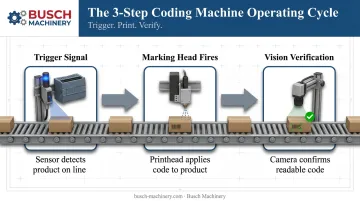
Vision verification is a smart add-on rather than a built-in feature on every coder. Specify it separately if traceability is a top priority.
Coding vs. Labeling: What's the Difference?
Coding and labeling get confused often, but they solve different problems:
| Aspect | Coding | Labeling |
|---|---|---|
| Data | Variable, non-artwork data such as lot numbers and dates | Fixed artwork and branding |
| Application | Printed inline, directly onto the product or package | Affixed as a separate, pre-printed material |
Coding machines are almost always installed inline within a filling, capping, or labeling system rather than running as a standalone station. That means speed compatibility and control-system integration matter just as much as the mark quality itself.
Why Accurate Coding Matters for Compliance
Regulatory requirements vary by product and jurisdiction, so it pays to know exactly what applies to your line.
For pharmaceutical packagers, the FDA's DSCSA product identifier requirements mandate that each package carry a standardized numerical identifier, lot number, and expiration date in both human- and machine-readable form, typically a 2D data matrix code.
Food manufacturers face a different landscape. Federal law doesn't require date labels on most products, but FSMA traceability rules do require covered facilities to assign traceability lot codes for certain foods and events.
That obligation lives in your records, not necessarily on the package. Still, a legible, consistent code makes tracing and recall response dramatically faster.
Types of Coding Machines and Marking Technologies
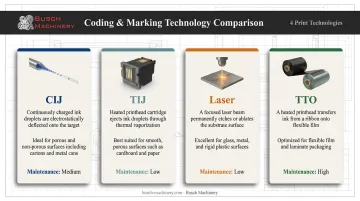
Most industrial coding equipment falls into four categories. Each has distinct mechanics, running costs, and ideal use cases, and the right pick depends heavily on your substrate and code requirements. Busch Machinery sources inkjet, laser, and thermal transfer coding systems across these categories as part of complete packaging line builds, matching printer type to substrate and speed requirements.
Continuous Inkjet (CIJ) Printers
CIJ printers push a continuous, electrically charged stream of ink droplets, deflecting selected drops to form a non-contact code on the moving product. Because the print head never touches the surface, CIJ handles curved, uneven, or fast-moving items well.
- Works across porous and non-porous substrates, including glass, plastic, metal, and cable
- Well suited to high-speed lines needing simple date and lot codes
- Requires ongoing ink and make-up fluid replenishment
Thermal Inkjet (TIJ) Printers
TIJ works much like a desktop inkjet printer: heat rapidly ejects precise ink droplets from a cartridge. The result is a sharper, higher-resolution mark than CIJ typically produces.
- Best for cartons, flexible packaging, and paper where clean barcodes or QR codes matter
- Cartridge-based, which simplifies routine maintenance
- Ink and substrate need to be matched carefully for adhesion
Laser Marking/Coding Machines
Laser systems use a focused beam to etch or ablate the substrate surface itself rather than adding ink. That produces a permanent mark with no consumables involved.
- Best suited to anti-counterfeiting applications and high-speed lines
- Common on plastic, glass, coated metal, and film
- Higher upfront investment, but minimal ongoing maintenance since there's no ink or ribbon to replace
Thermal Transfer Overprinting (TTO)
TTO uses a heated printhead to transfer ink from a ribbon onto flexible film as it moves through the machine. It's the go-to choice for small, high-contrast text on soft packaging.
- Delivers sharp, legible text favored in food and pharmaceutical flexible packaging
- Specifically built for film substrates, not rigid containers
- Ribbon consumption and printhead wear are the main ongoing costs
Key Industries That Rely on Coding Machines
Coding requirements shift depending on what you're packaging and where you're selling it. Three sectors lean on this equipment most heavily.
Food & Beverage
Expiration dates, batch codes, and freshness tracking help meet food-safety expectations. The FDA's HACCP guidance recommends lot coding of raw materials and finished products, so a recall system can trace and pull affected goods quickly and completely.
Pharmaceutical & Nutraceutical
Lot and serial numbers plus expiration dates support both anti-counterfeiting efforts and supply-chain traceability regulations. Serialization requirements under the Drug Supply Chain Security Act (DSCSA) extend well beyond the marking equipment itself, but the coder is where compliance starts.
Chemical & Cosmetic Manufacturing
Batch traceability supports regulatory audits and brand protection. In the EU, Cosmetics Regulation 1223/2009 specifically requires a batch number or reference identifying the product, whether on the container or the packaging. U.S. cosmetic labeling rules don't carry the same blanket mandate, so market-specific compliance checks matter here.
Key Benefits of Using Coding Machines on a Packaging Line
Beyond meeting regulatory checkboxes, coding equipment delivers operational value that shows up on the plant floor daily.
- Faster recall response: clear, consistent lot coding lets teams trace and isolate affected product quickly instead of guessing
- Simplified compliance: automated date, batch, and lot printing removes the need for manual entry on every run
- Fewer errors, less labor: automated coding restricts manual entry and job selection, cutting the wrong-code mistakes common with hand-stamping
- No bottlenecks: properly matched coding speed keeps pace with high-speed fillers and labelers instead of slowing them down
The common thread: a well-integrated coder protects your line's throughput while keeping compliance requirements met.
How to Choose the Right Coding Machine for Your Operation
Picking a coding technology comes down to a handful of practical questions, in this order.
- Check substrate compatibility first. CIJ works across many surfaces; TTO is film-specific. Don't fall in love with a technology before confirming it will actually adhere to and mark your packaging.
- Match print speed to your real line throughput. A coder rated for a vendor's best-case conditions may run slower with your code height, line count, and product spacing. Ask for a trial run on your actual line.
- Decide how permanent the code needs to be. Laser marking etches the substrate itself, making it tamper-resistant and ideal for anti-counterfeiting. Inkjet and TTO cost less upfront but rely on consumables.
- Calculate total cost of ownership, not just sticker price:
| Technology | Upfront Cost | Ongoing Costs | Maintenance |
|---|---|---|---|
| CIJ | Moderate | Ink, make-up fluid | Regular cleaning/filters |
| TIJ | Moderate | Cartridges | Low, cartridge swaps |
| Laser | Higher | None (no ink/ribbon) | Minimal |
| TTO | Moderate | Ribbon, printhead wear | Ribbon changes |
- Plan for integration, not isolation. Coding machines rarely run alone. They need to communicate with upstream filling, capping, or labeling equipment and downstream reject or line-stop logic.
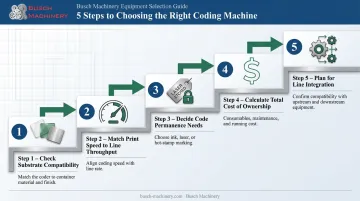
That last point is where a lot of coding projects go sideways. A coder that performs beautifully on a vendor's test bench can still create a bottleneck if it doesn't talk to your existing PLC or fit your line's physical footprint.
This is where working with a full-line packaging equipment supplier pays off. Busch Machinery has spent over 40 years, since 1983, supplying filling, labeling, capping, weighing, and end-of-line automation to manufacturers across food, pharmaceutical, and chemical industries.
Coding functionality often shows up as a built-in step on Busch-supplied equipment, such as cartoners and VFFS packaging lines, or as an add-on option rather than an isolated purchase. Because the team evaluates coding within the context of the whole line, not as a separate transaction, integration tends to go more smoothly and ROI arrives faster.
If you're weighing coding options against an existing or planned line, a consultation is a practical next step before committing to hardware.
Frequently Asked Questions
What is a coding machine used for?
Coding machines print variable data like dates, batch numbers, and barcodes directly onto products or packaging. This supports traceability, regulatory compliance, and quality control throughout the supply chain.
Which device is best for coding?
It depends on your substrate and permanence needs. Laser suits permanent marks on hard surfaces, CIJ (continuous inkjet) and TIJ (thermal inkjet) offer versatile high-speed printing, and TTO (thermal transfer overprinting) is built for flexible film packaging.
What's the difference between a coding machine and a labeling machine?
Coding machines print small, variable data inline at high speed. Labeling machines apply pre-printed adhesive labels carrying fixed artwork and branding.
How much does an industrial coding machine cost?
Pricing varies widely based on technology (inkjet vs. laser) and features like resolution or verification systems. Request a quote based on your specific line speed and substrate needs rather than relying on general estimates.
Can one coding machine work with multiple substrates?
Some technologies, like CIJ, are more substrate-flexible than others. Even so, mark quality and adhesion can vary depending on the material, so testing on your actual substrate is worthwhile.
How often do coding machines need maintenance or ink refills?
Inkjet systems need regular consumable refills and nozzle checks. Laser systems require minimal maintenance since they use no ink or ribbons, making them lower-upkeep over time.