Introduction
Picture a small cosmetics plant where two workers hand-fill jars of body butter, then pass each one down the line for manual capping. By hour six, fatigue sets in. Fill weights drift. Caps go on crooked. Output stalls well below what the order sheet demands.
This is the daily reality for manufacturers still relying on manual or semi-manual filling and closing. It's slow and inconsistent, and it caps how much you can scale.
A filling and sealing machine solves this by combining two critical functions into one continuous operation: precise product dosing and secure container closure. Instead of running separate filling and capping stations, everything happens in a single automated workflow.
Ahead, we break down how these machines work, the main types available, their real-world benefits, and how to choose the right one for your product and industry.
Key Takeaways
- Combines dosing and closing in one step, cutting labor and contamination risk
- Common formats include VFFS pouches, tube fillers, ampoule fillers, and liquid/powder systems
- Sealing method depends on packaging material: heat, induction, ultrasonic, or crimp
- Machine choice depends on product viscosity, packaging format, speed, and compliance needs
What Is a Filling and Sealing Machine?
A filling and sealing machine measures a precise quantity of product, whether liquid, powder, paste, or granule, into a container and then hermetically closes it, all within one automated workflow. No manual handoff between steps.
Compare that to running separate filling and capping units. The integrated approach:
- Reduces contamination risk by minimizing open-container exposure time
- Saves floor space since it's one machine footprint instead of two
- Increases line speed by eliminating the transfer delay between stations
These machines aren't one-size-fits-all. A tube filler works nothing like an ampoule filler. The container format (tubes, pouches, bottles, ampoules, or jars) dictates both the filling method and the sealing method used. You can't mix and match freely.
Beyond speed, these systems help maintain product integrity, extend shelf life, and support regulatory compliance. In pharmaceutical and food production especially, a poorly sealed container can trigger product recalls, contamination complaints, or regulatory citations.
Key Components of a Filling and Sealing Machine
Every filling and sealing machine, regardless of container type, shares a few core building blocks:
- Filling station: a hopper, dosing pump, or volumetric cylinder that measures and dispenses the exact product quantity per cycle
- Sealing station: applies heat, ultrasonic energy, or induction elements depending on the packaging material to create an airtight closure
- Control panel/PLC system: coordinates container indexing, filling accuracy, and sealing timing in sync
- Sensors: prevent the machine from dispensing product if a container isn't properly positioned, avoiding spills and waste
That last point matters more than it sounds. A misaligned container without a sensor safeguard means wasted product, a jammed line, or worse, a contaminated fill head.
How Does a Filling and Sealing Machine Work?
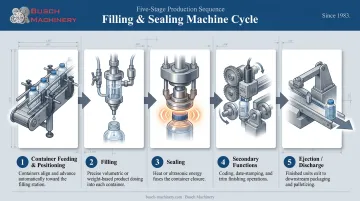
The basic cycle is consistent across formats, even though the mechanics differ by container type.
- Container feeding and positioning — empty tubes, bags, bottles, or ampoules are automatically indexed into place under the filling nozzle
- Filling — product is dosed volumetrically, by weight, or by fill-level sensor, depending on viscosity and the accuracy required
- Sealing — heat, pressure, or ultrasonic energy bonds or crimps the container shut immediately after filling
- Secondary functions — many machines handle batch/date coding, trimming excess film, or leak testing within the same cycle
- Ejection/discharge — sealed containers move to the next stage of the packaging line
Once this cycle is running, speed becomes the real differentiator between machines. In one documented case, a poultry producer running a vertical form fill seal machine rated up to 100 bags per minute actually operated at 50 bags per minute for its 2-lb bags. That works out to 3,000 bags per hour, proof that nameplate maximum speed and actual product-specific throughput are two different numbers.
Always ask a supplier for the real-world rate on your product, not just the machine's ceiling.
Not every machine performs every secondary function. Some rely on connected inline inspection systems for leak testing rather than building it into the filler itself. When comparing quotes, clarify exactly what's included in the base cycle versus what requires add-on equipment.
Types of Filling and Sealing Machines
Machines are generally categorized by the container format they process, since filling and sealing mechanisms vary by material. A machine built for pouches won't handle ampoules, and vice versa.
Vertical Form Fill Seal (VFFS) Machines
VFFS equipment forms pouches from a roll of film, fills them with product, and seals them vertically in one continuous process. The film unwinds, wraps around a forming tube, gets a longitudinal seal down the side, receives product, then gets a transverse seal top and bottom before the finished pouch is cut away.
Busch Machinery's catalog includes a Tea Bag in Bag packaging system, a VFFS-type machine that forms, fills, and seals dual-bag tea products. It handles inner bag sizes from roughly 50-70mm and fill volumes as small as 3 grams. It's a good illustration of how specialized VFFS tooling can get for a specific product.
Tube Filling and Sealing Machines
These machines fill collapsible plastic or aluminum tubes with creams, gels, or pastes, then seal them using heat, ultrasonic energy, or mechanical folding. The sealing method depends entirely on tube construction:
- Plastic/laminate tubes — hot-air or heat sealing
- Aluminum tubes — mechanical fold-and-crimp sealing
- Either type — ultrasonic sealing, common where speed and clean seal edges matter
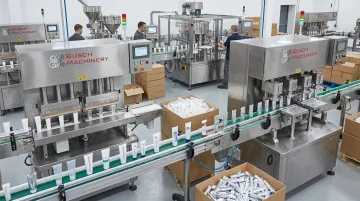
Busch Machinery offers several BM-series tube fillers built around this exact distinction:
- BMNF-30B — plastic tube filler and heat sealer for pharmaceutical and cosmetic products
- BMZF-60B — aluminum tube filler with fold-and-crimp sealing
- BUS-2020T — ultrasonic tube sealer for tabletop or semi-automatic lines
Ampoule Filling and Sealing Machines
Ampoule machines fill glass ampoules with liquid pharmaceuticals under sterile conditions, then seal them using flame or tip sealing. Container cleaning, sterilization, and depyrogenation happen before filling.
A controlled flame then softens the glass neck so it can be pulled and sealed into a hermetic closure. Given the aseptic requirements, these lines demand tight process control at every step, not just accurate dosing.
Liquid, Powder, and Paste Filling and Sealing Systems
Bottle, jar, and pouch systems pair a filling method to product behavior, then close with cap, induction, or heat sealing:
| Product behavior | Filling method | Typical closure |
|---|---|---|
| Thin, free-flowing liquid | Gravity or timed-flow | Cap, optional induction seal |
| Viscous liquid, cream, or paste | Piston/positive-displacement | Tube seal, heat-seal lid, or cap |
| Free or non-free-flowing powder | Auger | Heat-sealed pouch or capped container |
As PMMI's buying guidance notes, matching filler type to product viscosity and flow behavior is the first decision point before anything else about the machine matters.
Benefits of Using a Filling and Sealing Machine
Automation delivers three concrete advantages over manual or semi-manual lines.
Higher throughput, less labor dependency. Combining filling and sealing into one automated cycle removes the manual handoff that slows manual lines and introduces human error. You need fewer operators per shift, and the ones you do have can focus on quality checks instead of repetitive motion tasks.
Tighter dosing, less waste. Precision dosing minimizes product giveaway, the small overfill amount manufacturers add "just in case" to avoid underweight complaints. In one case documented by Ishida, a fresh-food producer cut giveaway from 7% down to 1% after switching to an automated weigher-integrated filling system. That's not a universal number every plant will hit, but it shows the scale of margin improvement precision dosing can unlock over time.
Compliance support. Consistent fill volumes and secure seals directly support regulatory requirements:
- Net-quantity labeling accuracy for food products
- Hermetic seal integrity for thermally processed low-acid foods
- Container-closure integrity for sterile pharmaceutical products
Busch Machinery's filling and sealing systems are built to meet these standards run after run, something manual filling struggles to guarantee.
Choosing the Right Filling and Sealing Machine for Your Business
Picking the right machine starts with the product, not the equipment catalog.
Start with product characteristics. Viscosity, particle size, and sensitivity to heat or oxygen determine whether you need a piston filler, a gravity filler, or an auger. A thick cosmetic cream and a thin liquid cleaner need entirely different dosing mechanisms, even if they're going into similar-looking bottles.
Match the machine to your packaging format. Tubes, pouches, bottles, and ampoules each require dedicated tooling. Retrofitting a machine built for one container type to handle another is often more expensive than buying the right equipment from the start.
Factor in speed and scalability. Single-head configurations work fine for lower-volume runs. Multi-head setups increase simultaneous dosing capacity for growing production needs, though actual line output is also limited by container handling, sealing dwell time, and inspection steps downstream.
Matching these variables to the right equipment often benefits from expert guidance. Busch Machinery has worked as a single-source packaging machinery supplier since 1983, serving chemical, pharmaceutical, cosmetic, and food and beverage manufacturers across the country from its Tucson, Arizona headquarters. The company's product line includes BM-series tube fillers and sealers, band sealers used in chemical and cosmetic packaging, and bottle-line equipment, alongside custom-sourced and third-party options for other container formats.
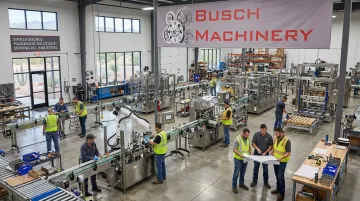
Its engineering team offers consultation to help manufacturers match the right filling and sealing solution to their specific budget and application before committing to a purchase.
Frequently Asked Questions
How much does a filling and sealing machine cost?
Cost varies based on automation level, output capacity, and container type. Since pricing depends on your specific production needs, request a tailored quote directly from Busch Machinery.
How does an ampoule filling and sealing machine work?
These machines fill glass ampoules with liquid product under sterile conditions, then seal the tip using flame or heat sealing. The result is a hermetic closure that protects the sterile product inside.
What is the filling process in manufacturing?
The general sequence includes container positioning, precise product dosing (volumetric, weight-based, or level-based), and immediate transfer to sealing or capping, all within one automated packaging line.
What are the different types of sealing used in filling and sealing processes?
Common methods include heat sealing (thermoplastic films and tubes), induction sealing (foil-lined bottle and jar caps), ultrasonic sealing (thermoplastic flexible packaging), and crimp sealing (vials with elastomeric stoppers).
What industries commonly use filling and sealing machines?
Food and beverage, pharmaceutical, cosmetic, and chemical industries all rely on these machines wherever consistent dosing and secure closure are required for product safety and shelf life.
Can filling and sealing machines be customized for different container types?
Many systems offer modular tooling and adjustable settings to accommodate different container sizes and materials. Busch Machinery can advise on which customization options fit your specific application.