Many breweries pour serious energy into label art and can graphics while treating fill accuracy, seaming quality, and line speed as an afterthought. That's a mistake. The wrong equipment choice can quietly eat into margins for years.
This guide covers the container formats available, how to choose between them, the machinery that brings packaging to life, and the compliance details that keep a brewery out of trouble.
Key Takeaways
- Cans, bottles, kegs, growlers, and crowlers each suit different distribution channels and shelf-life needs
- Match format choice to production volume, cost per unit, and brand positioning
- Automated filling, seaming, labeling, and quality checks boost throughput and ensure compliance
- Strong packaging design only succeeds when paired with a solid operational strategy
Types of Beer Packaging & Containers
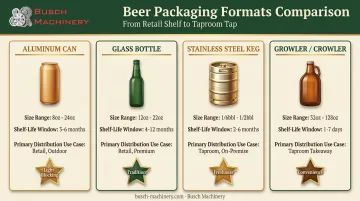
Four formats cover nearly every brewery's needs: cans, bottles, kegs, and the growler/crowler pair. Each one solves a different distribution problem.
Cans
Aluminum cans now account for 78% of Brewers Association-defined craft packaged volume, according to the Brewers Association's 2025 packaging trends report. That's not a close race anymore.
Common sizes include:
- 12 oz standard – the classic six-pack size, still widely used
- 16 oz tallboy – a popular middle ground for taprooms and retail
- 19.2 oz stovepipe – leads single-can sales, though singles are a small slice of total volume
Cans win on aluminum's light-blocking properties, low weight (cheaper shipping), and recyclability. There's no light-struck flavor risk here, unlike glass.
Bottles
Bottles still carry a premium, traditional feel that resonates with certain drinkers, especially for barrel-aged or specialty releases. Standard sizes run:
- 12 oz – the everyday bottle
- 22 oz bomber – common for higher-ABV or limited releases
- 750mL Belgian-style – used for premium, cellar-worthy beers
Brown glass blocks light far more effectively than green or clear glass, which matters for hop-forward beers prone to skunking. Crown caps seal the deal, though the exact oxygen ingress varies by cap design and gasket quality.
Kegs
Kegs move beer straight to the tap with minimal oxygen exposure between the brewery and the glass. Standard U.S. sizes include:
| Keg type | Capacity |
|---|---|
| Half barrel | 15.5 gallons |
| Quarter barrel | 7.75 gallons |
| Sixth barrel | 5.17 gallons |
| Cornelius (Corny) | 5 gallons |
Non-pasteurized draft beer typically holds for 45-60 days at or below 38°F, while pasteurized draft stretches to 90-120 days under the same cold-chain conditions.
Growlers & Crowlers
Refillable glass growlers and single-use aluminum crowlers both bridge the gap between taproom pour and take-home beer, but they behave very differently.
- Growlers: reusable, require sanitation between fills, best opened within 24-72 hours
- Crowlers: seamed immediately after filling, single-use, best consumed within 2-3 days when kept cold
Neither format offers the shelf stability of a canning or bottling line, so treat them as short-window, taproom-adjacent products.
Choosing the right container is only the first decision. Matching it to the correct filling, capping, or labeling equipment determines whether that format actually runs smoothly on your production floor. Busch Machinery supplies filling, capping, and labeling systems configured for canning, bottling, and keg lines, so breweries can equip their operation around whichever containers fit their distribution strategy.
Choosing the Right Beer Packaging Solution for Your Brewery
Picking a packaging format is an operational decision that shapes volume planning, budget, and distribution strategy.
Start with production volume. A brewer filling 20 kegs a week doesn't need the same equipment as one running 10,000 cans a day.
Small-batch operations often start manual or semi-automatic, then layer in automation as volume climbs. Busch Machinery, for instance, supplies equipment ranging from tabletop semi-automatic fillers to high-speed automatic lines, so breweries can scale up without tying up capital that could go toward tanks or ingredients instead.
Match the format to the distribution channel:
- Retail shelf sales point toward cans or bottles
- Taproom-only sales work fine with kegs, growlers, or crowlers
- Bar and restaurant accounts almost always mean kegs
Sticker price isn't the only cost driver. Canning equipment tends to cost more upfront than bottling gear for smaller operations, and can suppliers sometimes impose larger minimum order quantities. Many breweries actually start with kegs, then add bottles or cans once cash flow and production scale allow it.
Hop-forward IPAs and barrel-aged beers are especially vulnerable to light and oxygen damage, which makes amber glass or cans with strong seam integrity non-negotiable for shelf-life-sensitive styles.
Sustainability increasingly factors into the decision, too. In Trivium's 2023 survey of more than 9,000 consumers, 82% said they'd pay more for sustainable packaging, and that number jumped to 90% among Gen Z respondents. Aluminum cans already lead in recyclability, giving them a direct edge as this consumer expectation grows.
Beer Packaging Machinery & Equipment Solutions
Choosing cans over bottles, or kegs over crowlers, only answers half the question. The machinery behind that format determines whether the brewery actually hits its throughput targets, or spends its days troubleshooting jams and inconsistent fills.
Filling accuracy is the foundation. Overfilling wastes product across thousands of units. Underfilling risks compliance violations tied to net contents labeling. Busch Machinery's filling systems are built around precision and reliability, helping breweries avoid both problems while keeping fill volumes consistent batch after batch.
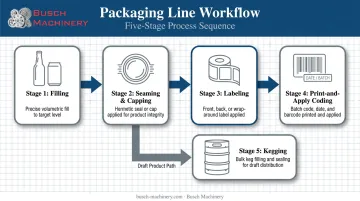
Beyond filling, a few equipment categories matter most:
- Seamers and cappers – seal cans and bottles with consistent pressure, protecting against oxygen ingress
- Labelers – apply front, back, or full-wrap labels; Busch Machinery offers wrap labelers like the BM-LCW and BMADL-300, plus front-and-back systems like the BM-MS-100
- Print-and-apply systems – add lot numbers, dates, and barcodes for traceability, with models like the BM-KPA built for inline use
- Kegging equipment – fills kegs with minimal oxygen pickup, protecting draft freshness through distribution
Automation doesn't just speed things up. It reduces the manual labor bottleneck that limits how much a growing brewery can pack out in a shift.
Quality control deserves attention at the end of the line, too. Checkweighers catch underfilled or overfilled containers before they ship, while metal detectors flag contamination risks.
Busch Machinery's BM-GC series combines both functions in a single unit. Models scale from smaller 12-inch systems handling around 40 pieces per minute up to larger 20-inch units running 120 pieces per minute.
For breweries unsure where to start, Busch Machinery works as a single-source packaging machinery partner, offering engineering consultation to help scale packaging operations cost-effectively, whether that means a first labeler or a full canning line integration.
Creative Packaging Ideas to Elevate Your Brand
Design still matters. It's just not a substitute for the operational choices above.
Craft Brewing Business's tracked design trends show where shelf-standout packaging is heading:
- 1960s psychedelia – bold, retro color palettes and swirling type
- Mischief-style illustration – playful, slightly irreverent artwork
- Text-centric labels – minimalist, typography-forward designs
- Y2K metallic and kitsch – chrome finishes and early-2000s nostalgia
- Faux 3D decoration – depth effects that make labels pop off the shelf
Consistency across every touchpoint matters as much as the design itself. A can, a keg collar, and a growler label should all read as the same brand at a glance: same color scheme, same logo placement, same name treatment.
That consistency depends on equipment too. Busch Machinery's print-and-apply labeling machines apply identical specs across can, keg collar, and growler formats.
Sustainability is shaping design decisions too. Beyond material choice, brands are leaning into refillable systems and recyclable content to match consumer demand. CMI reports that 84% of U.S. consumers expect products and packaging to be easy to recycle. Packaging design that visibly signals recyclability or reduced material use is becoming a differentiator, not just a compliance checkbox.
Beer Packaging Best Practices: Freshness, Shelf Life & Compliance
Shelf life depends heavily on format and process, not just the container material.
| Format | Typical shelf life |
|---|---|
| Pasteurized cans/bottles | 6-8 months unrefrigerated |
| Unpasteurized cans/bottles | 2-6 months, refrigerated |
| Pasteurized keg | 90-120 days, cold chain |
| Unpasteurized keg | 45-60 days, cold chain |
| Growler | Open within 24-72 hours |
| Crowler | 2-3 days, cold |
Pasteurization stabilizes beer microbially by inactivating spoilage organisms, but it doesn't stop chemical staling from oxygen exposure. That requires separate controls: CO2 purging, low-turbulence filling, underlid gassing, and dissolved-oxygen measurement at the filler.
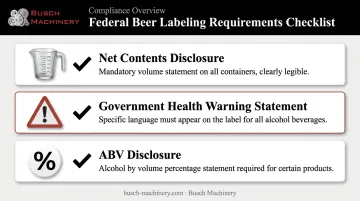
On the labeling side, federal rules require:
- Net contents disclosure in standard measures
- Government health warning statement for any malt beverage at 0.5% ABV or higher
- ABV disclosure, which is optional federally in most cases but becomes mandatory if alcohol comes from added flavors or other nonbeverage ingredients
Checkweighers and metal detectors round out the compliance picture, and Busch Machinery supplies combo units that handle both functions in a single pass. These systems catch fill inconsistencies and contamination risks before product ships, protecting regulatory compliance and a brand's reputation with distributors who expect consistent quality on every pallet.
Frequently Asked Questions
What are beer containers called?
The main types are cans, bottles, kegs, growlers, crowlers, and casks or barrels. Cans and bottles dominate retail, kegs handle draft, and growlers/crowlers cover taproom-to-home sales.
How long does beer last after packaging?
It depends heavily on format. Pasteurized canned or bottled beer can last 6-8 months, while draft or crowler-filled beer has a much shorter window, often just days.
What is the most popular beer packaging format for craft breweries today?
Cans, particularly 12 oz and 16 oz tallboys, now dominate craft packaging thanks to lower cost, portability, and strong shelf appeal. They represent roughly 78% of craft packaged volume.
What's the difference between pasteurized and unpasteurized packaged beer in terms of shelf life?
Pasteurization eliminates live yeast and bacteria, extending shelf stability. Unpasteurized beer needs refrigeration throughout and has a noticeably shorter freshness window.
How much does beer packaging equipment cost for a small brewery?
Costs vary widely based on format and automation level, ranging from a few thousand dollars for semi-automatic labelers to much more for full canning lines. Busch Machinery can provide a quote tailored to your production volume and budget.
Can a small brewery automate its canning and labeling process on a limited budget?
Yes. Scalable, budget-conscious automation options exist, from compact tabletop labelers to entry-level semi-automatic systems. An engineering consultation with Busch Machinery can help identify the right starting point for future growth.