Buyers researching capping equipment often run into vague product pages and marketing fluff instead of straight answers about how these machines actually work. That's a real problem when you're trying to spec out a production line on a deadline.
This guide clears up the confusion. We'll define "capper" in both its everyday and industrial senses, break down the machine types you'll actually encounter on a production floor, and walk through how to pick the right one for your operation.
Key Takeaways
- "Capper" has three meanings: a figurative finishing touch, gambling slang, and industrial capping equipment
- Capping machines seal containers using torque, pressure, or vacuum to secure caps
- Automation level (manual, semi-automatic, fully automatic) should match production volume, not vice versa
- Container size, cap type, and speed requirements determine the right capping mechanism
- Regulatory requirements, especially in pharma and food, demand consistent sealing
What Does "Capper" Mean? (The General Definition)
Before it meant anything mechanical, "capper" was already doing double duty in everyday English.
Merriam-Webster traces the word back to 1587 and lists three separate definitions. The most common usage today describes a finale, climax, or clincher, the kind of moment that wraps something up memorably. You'll see this in entertainment writing and news coverage constantly:
- "The capper to the evening was the surprise fireworks display."
- "It was the perfect capper to a wild election night."
- "His game-winning shot was the capper on an incredible season."
There's also a lesser-known slang meaning. Collins and Dictionary.com both define "capper" as a shill: an informer tied to gamblers, or a by-bidder planted at auctions to drive up prices artificially. It's an old term, and you won't hear it much outside of niche gambling or legal contexts.
In industrial and manufacturing settings, though, "capper" means something entirely different and far more literal: a person or machine that applies caps to containers. That's the definition this article focuses on from here forward.
What Is a Capper in Manufacturing and Packaging?
In a packaging line, a capper (or capping machine) is equipment built specifically to seal containers, bottles, jars, tubes, or jugs, by applying and securing a cap, lid, or closure.
The core job is simple to state but critical to execute: create an airtight, leak-proof seal that protects the product inside, prevents contamination, and satisfies regulatory requirements. FDA guidance on container-closure systems notes that maintaining adequate container integrity after sealing provides protection against microbial contamination and helps prevent quality issues like solvent loss.
How the Process Works
Most cappers follow the same basic sequence, regardless of automation level:
- Feed - Caps are delivered to the machine manually or through a feeder system
- Place - The cap is positioned onto the container opening
- Tighten - The machine (or operator) applies a specific torque or pressure to secure the seal
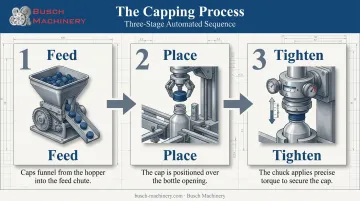
That third step matters more than most buyers realize. Too little torque and you get leaks; too much and you crack caps or strip threads.
Capping machines show up across a wide range of industries, including chemical, pharmaceutical, cosmetic, food and beverage, and nutraceutical manufacturing. Busch Machinery serves all of these sectors, each of which fills containers that need a secure, verifiable closure.
Modern cappers often include built-in quality checks like missing-cap detection and torque monitoring, catching defective seals before they leave the line rather than after a customer complaint.
Types of Capping Machines
Cappers vary along two dimensions: how much automation is involved, and what physical mechanism applies the cap. Understanding both helps you narrow down options fast.
Manual Cappers
These are hand-operated tools where an operator places and tightens each cap individually, often using a handheld pneumatic or powered tool for consistency. They're the right call for startups, labs, or very low-volume runs where investing in automation doesn't make financial sense yet.
Semi-Automatic Cappers
Here, the operator loosely places caps onto containers while the machine handles the actual tightening to a preset torque level. It's a solid middle ground: less physical strain than fully manual work, but without the cost or footprint of a full automatic line. Small-to-mid volume operations tend to land here.
Fully Automatic/Inline Cappers
These machines integrate directly into a conveyor line, using vibratory bowl feeders or pick-and-place systems to apply and tighten caps with zero manual intervention. They're built for high-speed production, often exceeding 200 containers per minute, where consistency and throughput matter more than flexibility.
Specialty Capper Mechanisms
Beyond automation level, the mechanism itself determines what closures a machine can handle:
- Chuck cappers - grip and torque screw-on caps with controlled precision
- Snap cappers - apply downward force to press-fit or snap-on lids
- Spindle cappers - spin multiple discs to tighten caps simultaneously as containers move along a conveyor
- ROPP cappers - roll aluminum caps onto bottle necks, creating a tamper-evident band as part of the sealing process
- Vacuum cappers - use steam or evacuation methods to create vacuum-sealed closures, common in hot-filled food jars
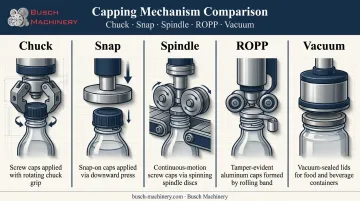
Matching mechanism to closure type isn't optional. A spindle capper won't handle a snap-on lid, and a snap capper can't form a ROPP closure.
Busch Machinery stocks all five mechanism types across manual, semi-automatic, and fully automatic platforms, making it easier to match equipment to your container and closure specs.
Why Businesses Invest in Capping Machines
Manual capping works fine at low volume. Past a certain point, though, it becomes the bottleneck holding your entire line back.
Labor and Throughput
Labor shortages are pushing more manufacturers toward automation across the board. PMMI's 2022 industry report found that 60% of companies said labor shortages were extremely impactful to their packaging and processing operations. Capping is one of the more repetitive, fatigue-inducing tasks on a line, which makes it a natural candidate for automation when volume justifies it.
Consistency Protects Your Brand
Inconsistent torque doesn't just cause the occasional leak. It creates:
- Product spoilage during shipping or storage
- Customer complaints and returns
- Brand reputation damage from inconsistent quality
Automated cappers apply the same torque every time, cycle after cycle, removing the human variability that causes most sealing failures.
Regulatory Compliance Isn't Optional
For pharmaceutical products, federal regulations mandate tamper-evidence as a baseline requirement, not an optional feature. Food and beverage products face similar mandates, with closure integrity checks required to prevent contamination during filling and sealing. In these industries, a properly calibrated capper functions as both an efficiency upgrade and a compliance safeguard.
How to Choose the Right Capper for Your Production Line
Picking a capper means matching equipment to your specific containers, caps, and production goals, not just chasing the fastest machine on the market.
Key Factors to Evaluate
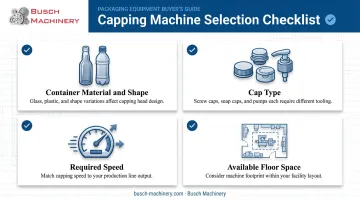
Before you start comparing machines, get clear answers on:
- Container material and shape - glass, plastic, and metal containers all behave differently under pressure
- Cap type - screw, snap, ROPP, or vacuum-sealed closures each need a different mechanism
- Required speed - measured in units per minute, based on your actual production targets, not theoretical maximums
- Available floor space - inline systems need more room than benchtop semi-automatic units
Look Beyond the Sticker Price
The purchase price is just one piece of the puzzle. Total cost of ownership includes:
- Ongoing maintenance and spare parts
- Changeover time between different cap or container sizes
- Integration costs with your existing filling and labeling equipment
A cheaper machine that requires constant tooling changes or frequent service calls often costs more over its lifespan than a slightly pricier, better-fitted alternative.
That fit-over-price principle is exactly how Busch Machinery has operated as a single-source packaging machinery supplier since 1983. Their engineering team evaluates how a capper fits with your filling, labeling, conveying, and end-of-line equipment, rather than treating it as a standalone purchase.
That matters because a capper that runs beautifully on its own can still create bottlenecks if it's mismatched with your filler's output speed.
Whether you're specifying a compact semi-automatic unit for a growing operation or a multi-head inline system for high-volume production, the right fit depends on details a catalog listing can't capture. Reaching out to Busch Machinery's sales team gets you a recommendation built around your actual containers, caps, and budget.
Frequently Asked Questions
What does capper mean?
Informally, "capper" describes a finishing touch or climax, like the capper to a great story. In industrial contexts, it refers to a machine (or person) that applies caps to containers on a production line.
What is the difference between a capper and a capping machine?
The terms are used interchangeably in most industrial settings. "Capper" can also refer to a human operator performing the task manually, while "capping machine" always refers to the equipment itself.
What industries use capping machines?
Pharmaceutical, food and beverage, cosmetic, nutraceutical, and chemical manufacturers all rely on capping machines. Any industry that fills containers needing a secure, verifiable seal is a candidate.
How does an automatic capper work?
Caps are fed into the machine through a vibratory bowl or pick-and-place system, then placed onto containers moving along a conveyor. The machine tightens each cap to a specific torque, all without manual intervention.
Can one capping machine handle different cap types and container sizes?
Many modern cappers are adjustable within a defined range, but very different cap or container formats usually require tooling changes or a different machine entirely. Check the size range before assuming compatibility.
How much does a capping machine cost?
Pricing varies widely based on automation level and head count, from a few thousand dollars for manual tools to well over $20,000 for multi-head automatic systems. Contact Busch Machinery for a quote based on your specific containers and volume.