
Introduction
You perfected the recipe. Customers keep reordering. Then a distributor asks for 500 units by Friday, and your hand-scooping and heat-sealing setup can't keep up.
This is where most small food producers hit their first real wall. Manual packaging creates inconsistent seals, wastes product through inaccurate fills, and eats labor hours you don't have to spare.
The global food packaging equipment market is projected to grow from $24.23 billion in 2026 to $39.80 billion by 2034, a 6.40% compound annual growth rate. Small-scale equipment options are a growing part of that expansion.
Ahead, you'll find the machine types built for small operations, how to match equipment to your product, real cost factors, and the mistakes that trip up first-time buyers.
Key Takeaways
- Compact, affordable packaging machines exist for small producers, not just large manufacturers
- Machine choice depends on product type, volume, floor space, and compliance needs
- Costs range from a few thousand dollars for semi-automatic units to six figures for automated lines
- A single-source supplier shortens installation time and simplifies scaling as you grow
Why Packaging Automation Matters for Small Food Businesses
Manual packaging feels manageable until order volume climbs. Then the hidden costs surface fast.
Inconsistent seals lead to returns, spoiled inventory, and customer complaints. Labor costs climb as you hire more hands to scoop, seal, and label by hand.
Then a big wholesale order lands, and you can't fulfill it on time. You either turn the business away or scramble with costly overtime.
Food processors nationwide are already feeling this pressure. Labor is scarce, hard to retain, and requires ongoing training, according to Food Engineering, a trend that hits small producers with thin margins especially hard.
What Automation Actually Delivers
Bringing in the right machine isn't just about speed. It changes the economics of your production line:
- Reduces product giveaway through accurate filling and real-time weight monitoring
- Speeds up order turnaround, letting you accept bulk and wholesale orders you'd otherwise decline
- Supports compliance requirements, including consistent net weight and seal integrity
- Delivers a more consistent, professional look on shelf, which matters when you're competing against established brands
Overfilling might seem like a minor issue, but it compounds. A 2-gram overfill on a 16-ounce bag, repeated across 10,000 units a month, adds up to real dollars lost every month. Accurate filling equipment closes that gap while also giving you the data to catch problems before a customer does.

Types of Food Packaging Machines for Small Businesses
Your product's physical format, whether liquid, powder, granular, or solid, determines which machine category actually fits. Map that out before you start comparing equipment, because a machine built for powders won't handle a chunky salsa well, and vice versa.
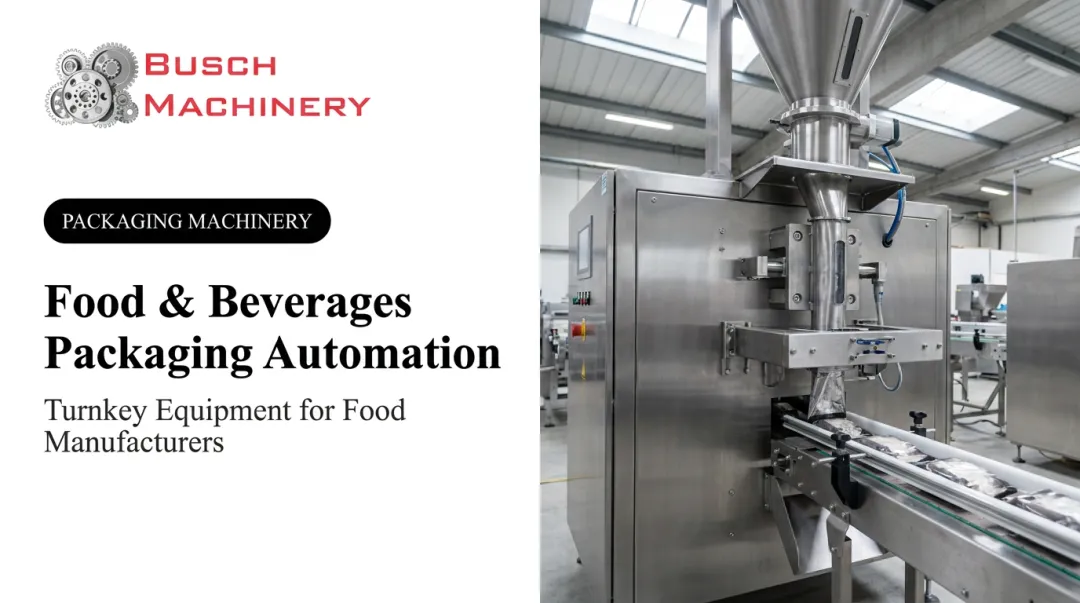
Vertical Form Fill Seal (VFFS) Machines
VFFS machines form a bag from rollstock film, fill it, and seal it in one continuous motion. This makes them a strong fit for:
- Snacks and chips
- Spices and seasoning blends
- Grains, rice, and granular dry goods
- Powders like protein mixes or flour blends
Compact VFFS models are built for small-to-mid volume producers who don't need industrial output but still want consistent, automated bagging instead of hand-filling premade pouches.
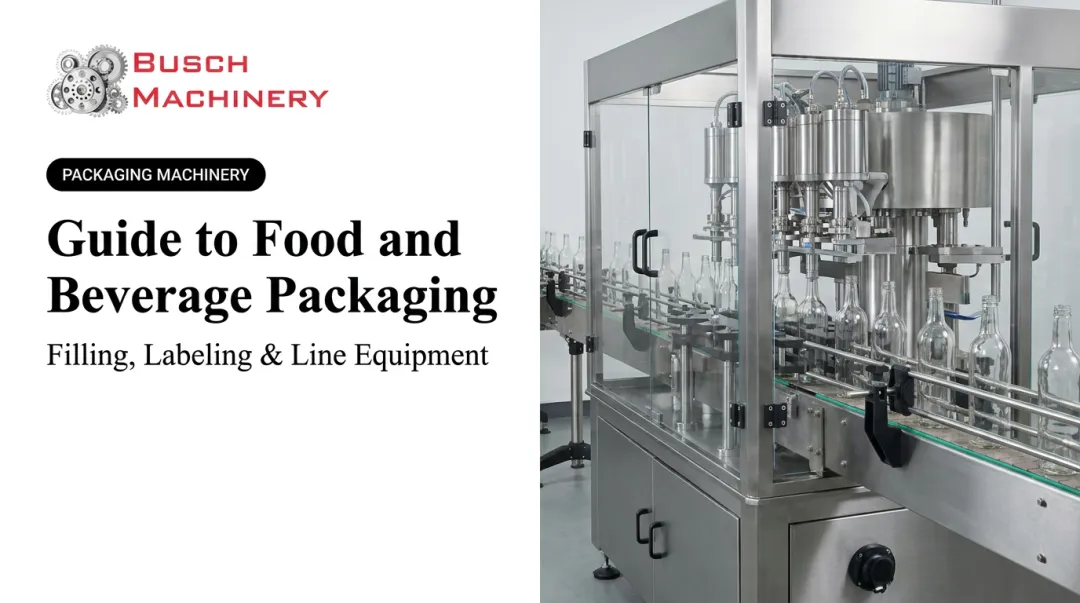
Filling, Capping & Labeling Equipment
Liquid and semi-liquid products, think sauces, dressings, oils, and beverages, need a different approach entirely. Entry-level tabletop and benchtop systems let startups automate without committing to a full production line.
Busch Machinery's catalog, for example, includes options across a wide viscosity range:
- Siphon fillers for low-viscosity liquids in glass, plastic, or metal containers
- Rotary valve piston fillers for thicker sauces or products with visible bits or chunks
- Monoblock fillers and cappers, which combine filling and capping into one compact unit for small-batch bottling
- Tabletop tube fillers for pastes, condiments, and creams packaged in tubes rather than bottles
Semi-automatic labelers round out the setup, with benchtop models that handle round containers without requiring change parts for every size swap.
Multihead Weighers & Check Weighers
For snacks, nuts, and granular goods, precision fill weight is where profit either survives or leaks away. Multihead weighers divide product across several small hoppers and combine the closest match to target weight, cutting overfill dramatically compared to manual scooping.
Compact models built for smaller batches, like carbon-steel 10-head or 14-head units, handle products such as candy, nuts, seeds, and raisins at speeds up to roughly 65 packs per minute. Check weighers then verify that packaged weight matches the label before shipment, which matters for both compliance and customer trust.
Flow Wrappers & Pouch Fillers
Individually wrapped items, granola bars, cookies, single-serve snacks, need flow wrappers. Stand-up or premade bags need pouch fillers instead. Both categories now come in compact-footprint versions designed to fit tight kitchen or shared-facility workspaces rather than a dedicated warehouse floor.
Metal Detectors & Quality Control Equipment
Metal detection often becomes necessary for HACCP compliance once a hazard analysis identifies metal inclusion as a realistic risk. Small producers don't need to overhaul an entire line to add this protection. Compact inline units integrate into an existing setup, screening product as it passes through without requiring a rebuild of your whole workflow.

How to Choose the Right Packaging Machine
Assess Your Product Type & Packaging Format
Your product's consistency dictates the filling mechanism you need:
| Mechanism | Best For |
|---|---|
| Auger | Powders and granular products |
| Piston | Liquids, creams, sauces, pastes |
| Volumetric cup | Free-flowing dry goods (rice, nuts, candy) |
Test your actual recipe on candidate equipment before buying. Particulate size, density, and flow behavior all affect which mechanism performs consistently.
Plan for Production Volume & Space Needs
Estimate your current order volume, then project 12 to 24 months out. Buying equipment sized for output you won't reach for years wastes capital and floor space, and buying too small means you'll outgrow the machine before it pays for itself.
Space constraints matter just as much. Measure your actual floor space, not just the empty-looking corner you have in mind. Compact semi-automatic machines fit small kitchens and shared commercial facilities far more easily than industrial-scale lines, which often need dedicated utility hookups and clearance for operators and maintenance access.
Check Compliance & Sanitary Design Standards
Even small-batch producers need equipment that meets food safety expectations. Under 21 CFR 117.40, food-contact equipment must be adequately cleanable, corrosion-resistant, and made of nontoxic materials that can withstand the food and the cleaning process itself.
Stainless steel is a common way manufacturers satisfy this, but it's the cleanability and corrosion resistance that matter for compliance, not the material label alone. Confirm the specific construction and finish of any machine you're evaluating.
Plan for Scalability & Ongoing Support
Look for equipment that can be upgraded rather than replaced outright as volume grows. Working with a single-source supplier that offers engineering consultation and machinery support, such as Busch Machinery, simplifies this. You get one point of contact as your line expands instead of coordinating between five different vendors.

How Much Does a Food Packaging Machine Cost?
Pricing depends heavily on automation level, output speed, and customization, so treat any published range as a starting point, not a quote.
Semi-automatic and tabletop units sit at the entry tier. These include manual-assist fillers, benchtop labelers, and tabletop sealers built for startups and small-batch production. They typically cost the least of any category and require an operator present for each cycle.
Mid-range automatic machines, including VFFS units, flow wrappers, and filling/capping monoblocs, represent the next investment tier. These run with less operator involvement and higher throughput, which fits growing producers fulfilling regular wholesale orders.
Fully automated end-to-end lines integrating weighing, filling, sealing, and quality control sit at the top of the range. This tier suits producers running high, consistent volume across multiple SKUs.
What Actually Drives the Price
- Automation level (manual-assist vs. fully automatic)
- Machine speed and output capacity
- Customization for container size, pouch style, or fill volume
- Added quality control components, like checkweighers or metal detectors
These factors combine differently for every buyer, which is why upfront cost alone doesn't tell the full story.
Calculating Your ROI
Compare upfront cost against three savings categories: labor hours reclaimed, product waste reduced through accurate filling, and additional order volume you can now accept. Because product mix, current labor cost, and waste rates vary by business, there's no universal payback timeline that applies across the board.
Request a personalized quote from Busch Machinery based on your specific product and volume rather than relying on generic estimates. This gives you numbers you can actually plan around.
Common Mistakes to Avoid & Choosing the Right Partner
Common Mistakes Small Businesses Make When Buying Packaging Machines
Overestimating capacity needs. Buying a machine sized for 10 times your current output ties up capital that could go toward marketing, ingredients, or hiring. It also eats floor space you may not have to spare.
Underestimating after-sales support needs. A machine that breaks down without accessible spare parts or technical help translates directly into lost production days. Ask about support availability before you sign a purchase order, not after.
Why Partner with an Experienced Single-Source Supplier
Sourcing filling, capping, and quality control equipment from separate vendors creates compatibility headaches and slows installation. Busch Machinery solves this by operating as a single-source packaging machinery supplier since 1983, with a catalog spanning filling, labeling, capping, VFFS, multihead weighing, check weighing, and end-of-line automation.
That breadth matters for a growing food business because:
- Source multiple line components from one company instead of juggling several vendors
- Get engineering consultation that matches equipment to your actual product and budget, not a generic recommendation
- Troubleshoot faster with a supplier who already knows your complete setup
For a tailored recommendation, reach out to Busch Machinery directly at 800-840-9573 or by email at Sales.Inquiries@Busch-Machinery.com.
Frequently Asked Questions
What is the cost of a packaging machine?
Cost varies widely, from a few thousand dollars for semi-automatic tabletop units to well over six figures for fully automated lines. Request a tailored quote based on your specific product and production volume for accurate pricing.
What size packaging machine is right for a small food business?
Match the machine's footprint and speed to your current production volume, leaving some room for modest growth. Buying far beyond your near-term needs wastes both capital and floor space.
Can one machine handle different food products like liquids, powders, and solids?
Most machines are format-specific, since liquids, powders, and solids each require different filling mechanisms. Some equipment offers customizable filling options, but confirm compatibility with your exact product before purchasing.
How long does it take to see a return on investment for a packaging machine?
ROI depends on your labor savings, waste reduction, and order volume, so there's no single universal timeline. Build a case-specific estimate comparing your current costs against the equipment's expected output and savings.
Do small food businesses need certified or compliant packaging machines?
Yes. Food-contact equipment must be adequately cleanable, corrosion-resistant, and made of nontoxic materials under federal regulations, regardless of your production scale. Sanitary design protects both your customers and your ability to sell through retail channels.
What ongoing maintenance do food packaging machines require?
Routine cleaning, periodic calibration, and scheduled part replacement are standard across most equipment. Choosing a supplier that offers repair and technical support reduces downtime when something needs attention.